
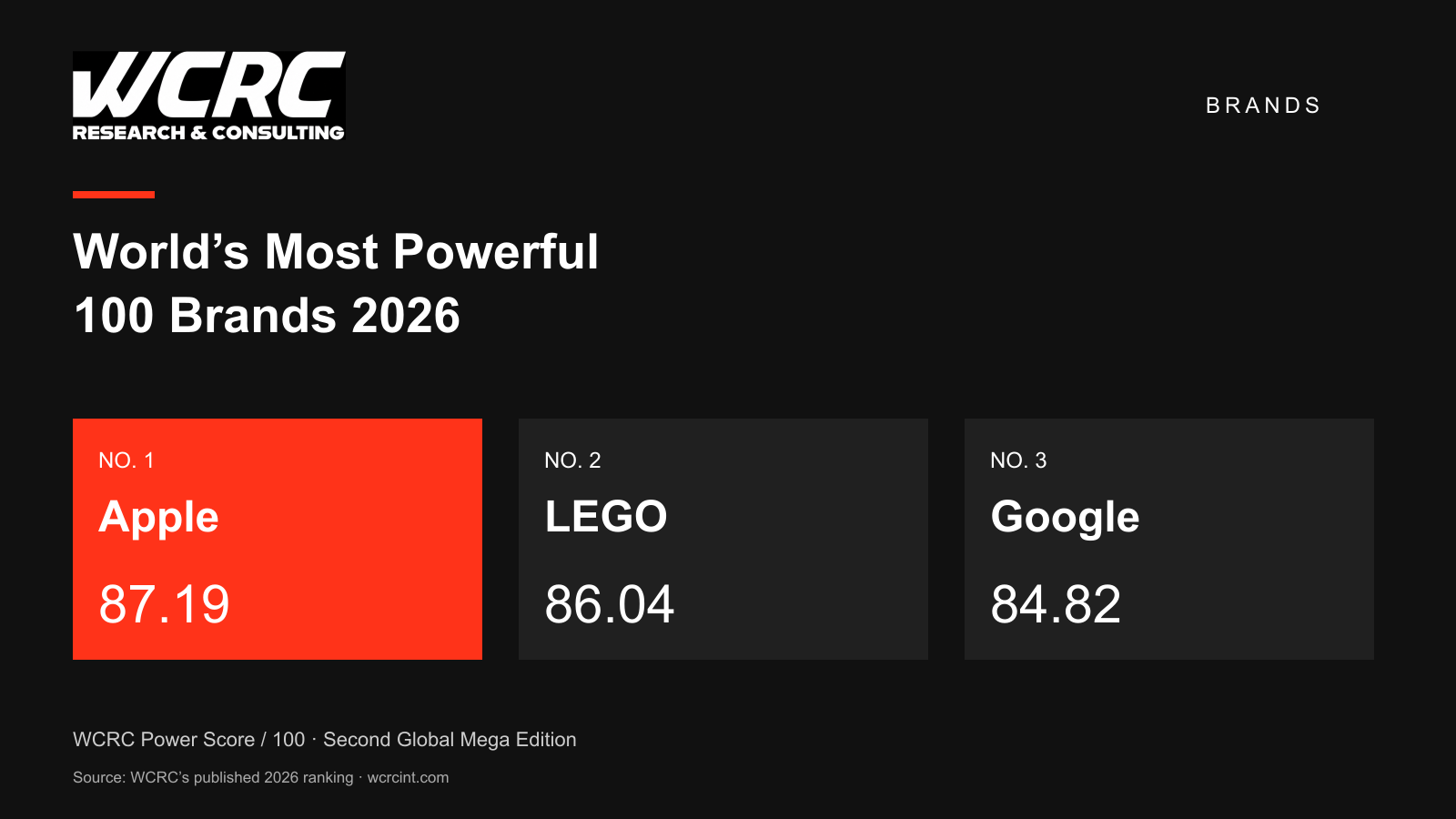
Apple ranks first in WCRC’s World’s Most Powerful 100 Brands 2026, with a WCRC Power Score of 87.19 out of 100. LEGO follows at 86.04 and Google at 84.82. The result puts a technology company, a toy business and a digital platform at the top of the same assessment, each with a different basis for its relationship with customers.
The Second Global Mega Edition ranks 100 brands from a research universe of 579 brands across 43 countries. WCRC’s published methodology records that 297 brands received a full assessment across 50 parameters before the final ranking. The full 2026 ranking gives readers access to each ranked brand’s assessment.
This is a ranking of brand power under WCRC’s framework. Its scores are analytical assessments, not monetary brand valuations. A score of 87.19 is not a percentage of consumers who prefer Apple, nor a forecast of investment returns.
The top 10
Apple, LEGO and Google are followed by Hermès and Nvidia. YouTube, Microsoft, Netflix, Amazon and Ferrari complete the top 10. Their order and scores are set out below.
| Rank | Brand | WCRC Power Score / 100 |
|---|---|---|
| 1 | Apple | 87.19 |
| 2 | LEGO | 86.04 |
| 3 | 84.82 | |
| 4 | Hermès | 83.38 |
| 5 | Nvidia | 82.99 |
| 6 | YouTube | 82.66 |
| 7 | Microsoft | 82.58 |
| 8 | Netflix | 81.83 |
| 9 | Amazon | 81.59 |
| 10 | Ferrari | 81.33 |
Why the weights matter
WCRC’s model assigns 28% of the overall score to Brand Positioning & Recall and 26% to Consumer Trust & Sentiment. Together, those pillars account for 54% of the result. Product, Innovation & Delivery contributes 20%; Sustainability, Governance & ESG, 16%; and Digital Presence & Financial Soundness, 10%.
These choices shape the ranking. Recognition and trust together carry more weight than product delivery alone. A large business therefore cannot establish a high position solely through its scale. Readers comparing this list with another brand ranking should begin with the question each model asks and the weight it assigns to each answer.
Within WCRC’s published results, Apple has the highest Brand Positioning & Recall pillar score, at 93.0. LEGO leads Consumer Trust & Sentiment at 88.9. Google leads Digital Presence & Financial Soundness at 91.0. These are scores within this assessment; they should be read with the published methodology and the individual brand records.
LEGO gives the table a useful counterpoint
LEGO’s second place is particularly useful when interpreting a table led by technology brands. It shows how the framework can reward a customer relationship built around a physical product and repeated use. The trust pillar is its strongest relative distinction in the edition.
Our reading is that brand managers should examine the composition of a score before setting a target from it. A business with strong recall but weaker customer trust has a different problem from one whose customers value the product but struggle to explain what distinguishes it. The same aggregate score can conceal very different priorities.
The practical question is what customers encounter after recognising a name. Product quality, complaint handling and the consistency of delivery all sit within the wider framework. A campaign cannot, by itself, answer those operational questions. WCRC’s LEGO turnaround story offers a separate account of how product and business decisions shaped the company’s recovery.
A global list with a concentrated footprint
The published top 100 spans 23 countries and 12 sectors. The United States accounts for 46 entries. France has 10; Germany and Japan have seven each. These counts describe the composition of WCRC’s assessed list. They do not measure each country’s share of all global brands or of global consumer spending.
Technology & Digital has 17 entries, the largest sector group. Consumer & FMCG and Media & Entertainment each have 13. Hospitality & Travel has 12. The range gives readers several ways to use the results: compare global leaders, examine a sector, or look closely at the assessment of one brand.
We would treat those comparisons as a starting point for investigation. An airline and a software company face different delivery demands. Their overall positions become more useful when the reader examines the underlying pillar scores and the sector context rather than treating rank as a complete account of the business.
How to read the evidence
The methodology describes an assessment based on secondary evidence, including company reports and filings, regulatory records, credit ratings, published market data and coverage over the preceding 24 months. The scores are WCRC’s own. The methodology also states that a ranked brand, or its owning company, must publish official revenue.
That eligibility condition matters when interpreting both inclusion and absence. A brand outside the final 100 has not necessarily been judged to lack customer loyalty or commercial importance. The research universe, screening process and full-assessment stage are separate parts of the exercise.
The published framework describes ten parameters within each of its five pillars and a weighted calculation of the overall Power Score. It should not be presented as a new survey of 579 brands’ customers. Readers who need to substantiate a particular company claim should follow the evidence on that brand’s page and consult the original source.
Using the results
The strongest use of this ranking is a specific comparison: what differentiates a brand’s positioning, where its trust assessment is strongest, and which part of delivery or governance deserves closer attention. The published Apple, LEGO and Google records show how that reading can begin.
Ranked brands and their communications teams can cite the exact WCRC property, edition, position and score. Inclusion applies to the assessed brand; it should not be extended to every subsidiary, product or executive in its parent group. WCRC’s research independence policy separates qualification and standing from commercial participation.
The complete 2026 table remains the reference for the results. The order is an entry point. The explanation behind each score is where the management work begins.