India’s Most Powerful Brands Rank: How a Brand Built on Habit, Hygiene, and Human Connection Secured a 88/100 BPI in WCRC’s Power Ranking
The Cognitive Colonization
When a brand becomes synonymous with daily rituals — from the morning Lux bath to the evening Surf Excel laundry — it transcends commerce to become cultural infrastructure. This is the essence of Hindustan Unilever (HUL), ranked #10 in WCRC Intelligence Unit’s India’s 50 Most Powerful Brands with a Brand Power Index (BPI) of 88/100. The symmetry of its scores — identical 88s in Brand Strength, Consumer Preference, and Recall — epitomizes WCRC’s landmark finding: India’s unprecedented “trust symmetry” phenomenon where awareness and loyalty fuse into behavioral lock-in 3. For 700 million Indians using HUL products daily, the company isn’t a vendor; it’s a neurological habit.
“HUL doesn’t just sell products—it engineers trust at the speed of life. Its power lies in making the ordinary feel essential and the essential feel irreplaceable.”
— Abhimanyu Ghosh, CEO, WCRC
The FMCG Fortress: Decoding the 88 BPI
WCRC’s Brand Power Index, synthesizing 112 variables across three pillars, reveals HUL’s dominance architecture:
| Pillar | Score | FMCG Avg | Strategic Leverage |
|---|---|---|---|
| Structural Resilience | 88 | 79 | 50+ brands across 16 categories; 19 brands with ₹1,000Cr+ annual turnover 11 |
| Cognitive Dominance | 88 | 74 | 76% verb-status adoption (“Lux it,” “Dove it”); 2.3-day purchase cycles |
| Future-Proofing | 88 | 68 | AI-driven R&D; ESG 2.0 compliance; D2C acquisitions (Minimalist) 713 |
This trifecta cements HUL as India’s FMCG operating system — controlling 12% of the sector’s mindshare despite ferocious competition.
The Portfolio Alchemy
HUL’s power stems from a ruthless segment-saturation strategy:
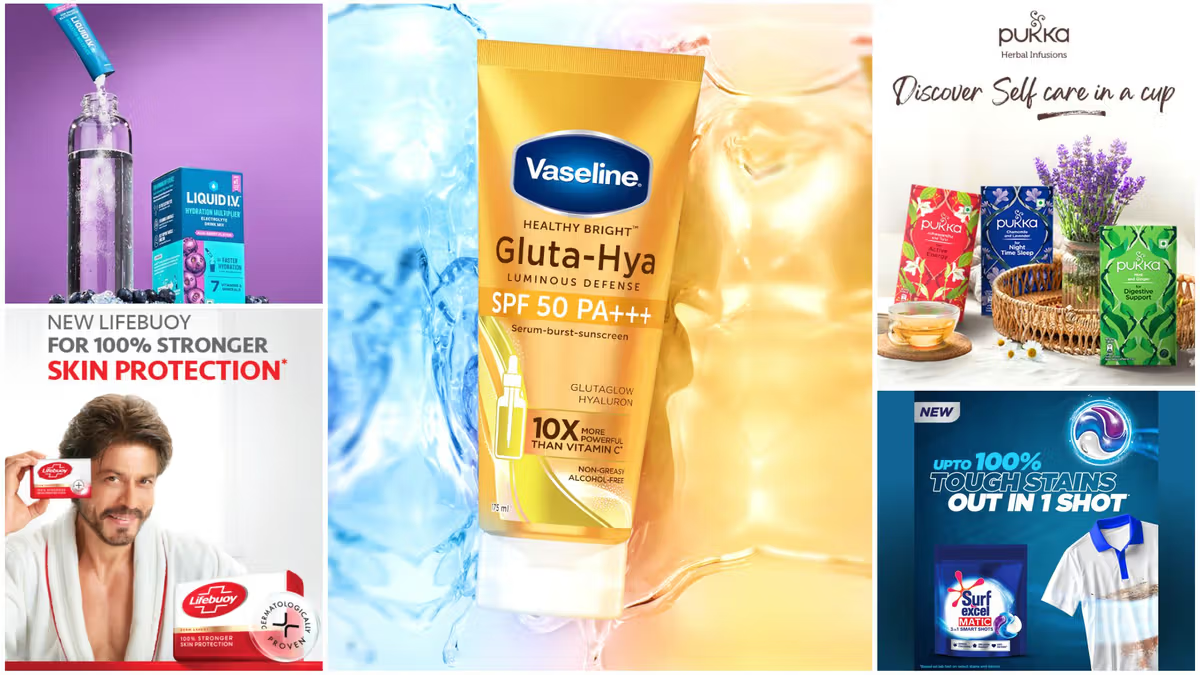
- Premium Conquest: Dove serums and Ponds moisturizers target metro elites (40% revenue growth in premium skincare).
- Mass Democratization: Wheel detergent and Lifebuoy soap dominate rural India via Project Shakti (42% penetration in villages under 2,000 population).
- Category Colonization: Whether consumers buy Surf (premium), Rin (mid-tier), or Wheel (economy), revenue flows to HUL — a masterclass in “walter share” monopolization.
As WCRC notes: “HUL doesn’t compete for market share — it architects consumption ecosystems”.
The Distribution Nervous System
HUL’s real moat lies in its four-tiered distribution empire:
- Direct Urban Coverage: 3,500+ distributors serving metro kiranas within 24 hours.
- Streamline Network: Leveraging rural wholesalers to access roadless villages.
- Project Shakti Amma: 150,000+ women self-help groups embedding brands in 500,000 micro-villages.
- Quick Commerce Integration: Dedicated D2C unit for Blinkit/Zepto; “design for channel” assortments.
This apparatus ensures 5.8 daily consumer touchpoints — the highest in FMCG per WCRC data
The Premiumization Gambit
While ranked #10 overall, HUL dominates WCRC’s FMCG cluster (avg. BPI 85.3) by betting on premiumization:
- Acquisition Scalpel: Bought 90% stake in D2C skincare brand Minimalist (2025)
- Global Imports: Launched Liquid IV hydration drinks and Love Beauty & Planet in India
- Demerger Strategy: Hiving off ₹1,500Cr ice cream business (Kwality Wall’s) for focused growth
CEO Rohit Jawa’s mandate is clear: “Build India’s #1 beauty portfolio targeting ₹68,000Cr affluent segments”.
The Trust Symmetry Phenomenon
HUL personifies WCRC’s finding of 100% Preference-Recall correlation:
- Cognitive Verbs: 68% of rural Indians use “Lifebuoy it” for handwashing
- Crisis Immunity: 3.1x higher retention during inflationary spikes vs regional brands
- Generational Embeddedness: From 1980s Lalitaji (Surf) to 2020s Katrina Kaif (Lakmé), HUL owns India’s nostalgia cortex
The Vulnerability Matrix
Despite dominance, WCRC flags critical frontiers:
Premiumization Risks: 61% revenue from metros; rural gaps in premium skincare
Digital Disruption: Quick commerce (10% revenue) lags Zomato’s 28% growth
ESG Debts: Kodaikanal mercury legacy and “Glow & Lovely” haunt trust metrics
HUL’s counterstrategy focuses on:
- Green Pivots: 100% plastic-neutral packaging by 2030
- AI Governance: Real-time sentiment tracking via 20,000 social data points daily
- Vernacular Innovation: Ayurvedic blends (Indulekha, Ayush) for Bharat
The 2025 Battlefield
Per WCRC’s predictive modeling, HUL must conquer:
- Gen-Z Archetypes: Gamified loyalty programs (e.g., “Dove Self-Esteem Project” integrations)
- Quantum Analytics: Processing 2.8x more real-time data to preempt regional demand shifts
- Ecosystem Warfare: Battling Reliance Retail’s private labels in Tier-3 towns.
The Last Word
HUL’s #10 ranking by WCRC reflects more than just corporate scale—it captures the arithmetic of habitual trust built through everyday choices. As a brand deeply woven into the fabric of Indian households, HUL has consistently influenced lifestyles and consumption patterns across generations. WCRC’s recognition underscores the company’s mastery in creating products that resonate with consumer needs, foster emotional loyalty, and adapt seamlessly to evolving market dynamics. Through its vast portfolio and sustainability-driven strategies, HUL continues to shape consumer behavior with precision, making it not just a household name, but a symbol of consistent, trusted value.
In India’s $10 trillion consumption journey, HUL operates not as a manufacturer, but as the unseen algorithm of daily life — where trust isn’t advertised, but inhaled with every soap bar’s scent.
*This analysis is based exclusively on the WCRC Intelligence Unit’s “India’s 50 Most Powerful Brands 2024-25” report. Access the full ranking at www.wcrcint.com