Open the knowledge
Strategy, data, skills and context that sit with the top team are shared as widely as safety and law allow.
In practice: The CEO publishes the reasoning behind major decisions to the whole organisation, not only the decision.
WCRC-GLC-02 — The Classical Acharyas
The WCRC Open Gopuram Model
Open the tower: share what you know with all.
THE MODEL
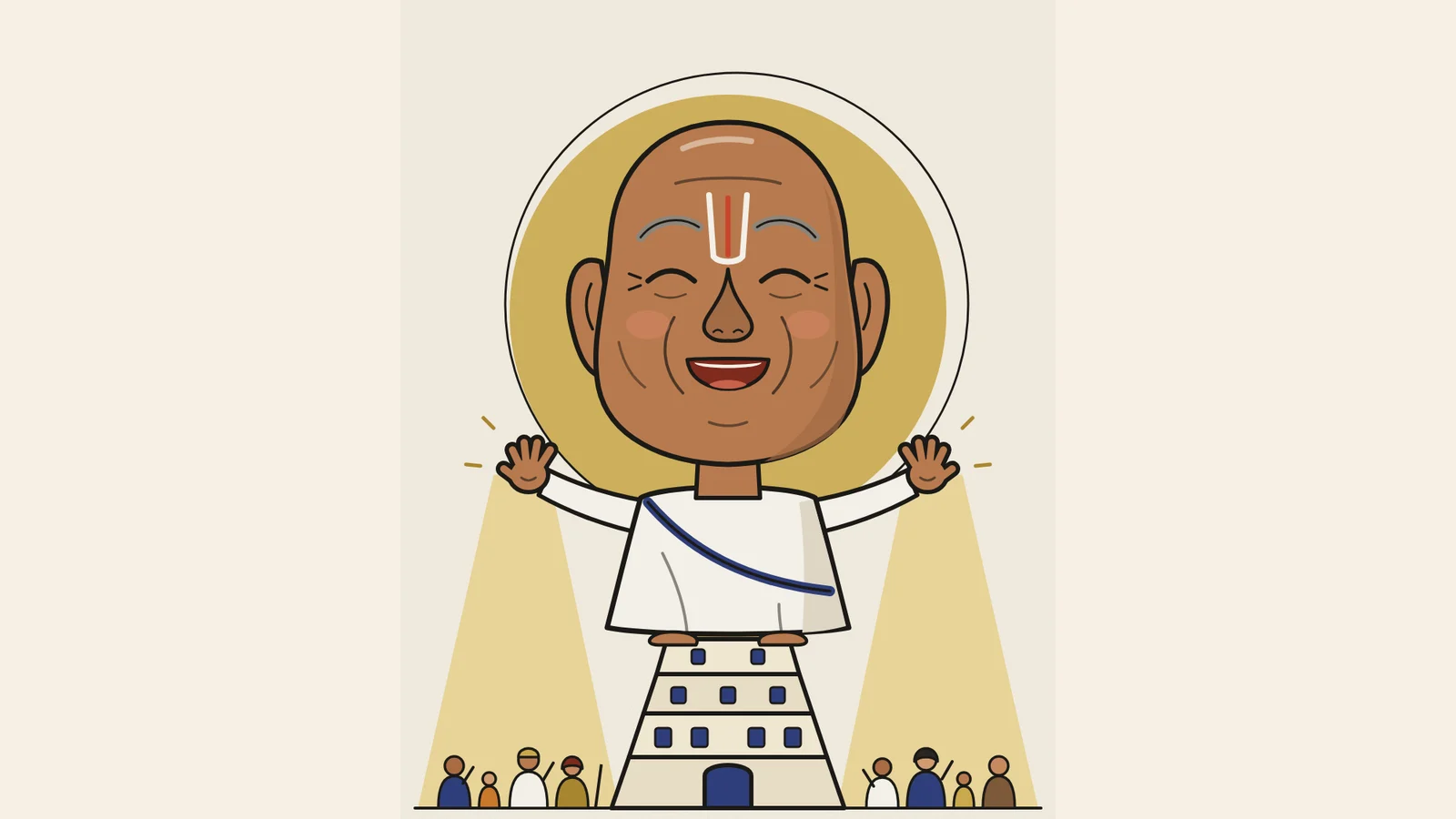
The Open Gopuram Model holds that knowledge hoarded at the top protects a few, while knowledge shared widely lifts the whole institution. It asks leaders to open access ring by ring, from the inner circle to the wider ecosystem, to let go of the ego of position, and to build a second line trusted enough to carry the work when the leader cannot.
Anchor teaching: The sacred mantra shared from the temple tower at Thirukoshtiyur
This is a selection of teachers linked with the Hindu tradition, not a ranking. The models offer management reflection, not religious instruction.
WCRC is not affiliated with or endorsed by any teacher or organisation discussed.
MODEL STRUCTURE
Strategy, data, skills and context that sit with the top team are shared as widely as safety and law allow.
In practice: The CEO publishes the reasoning behind major decisions to the whole organisation, not only the decision.
Remove the barriers of rank, background and credentials that decide who gets access to opportunity, tools and leaders.
In practice: The CEO reviews who gets training, stretch roles and new tools, and opens them to groups that have been left out.
Like taking refuge with no other refuge, the leader stops treating the title as the source of authority and accepts personal risk for the wider good.
In practice: The CEO accepts visible criticism for opening a gate, as Ramanuja accepted the warning on the tower.
Tradition holds that Kuresha went to the Chola court in Ramanuja's place. Loyalty of that kind is earned by sharing, and an institution needs successors who carry the work in the leader's absence.
In practice: The CEO names and develops successors for every critical role and gives them real authority before it is needed.
TEACHING AND CONTEXT
Devotees recount that after Thirukoshtiyur Nambi taught Ramanuja the sacred mantra and told him to keep it secret, Ramanuja climbed the temple tower and gave it to the crowd. Warned that he would go to hell for this, he said he would gladly do so if many were saved. His guru embraced him and called him "Emperumanar". Tradition holds this as the moment knowledge kept for a few became open to all.
Equality in devotion: caste does not decide who may approach God; he shared mantras and temple access widely.
Press Information Bureau; Statue of Equality site, as given in briefSurrender (prapatti) is a path open to all: for Ramanuja, surrender to the supreme Lord is the way to liberation, and no other way is needed.
Ramanuja, Vedartha Sangraha §99 (WCRC paraphrase)The world and people are real and sacred, not illusion to escape, so their welfare matters here and now.
Internet Encyclopedia of Philosophy (Shyam Ranganathan), as given in briefAs a young man he befriended and learnt from Kanchipurna, a temple servant of a lower caste, defying custom.
Brief, life milestones (tradition)OPERATING MODEL
BENEFIT MODEL
The leader is no longer the single gate for knowledge, which frees time and lowers the risk of the organisation depending on one person.
People at every level gain access to context, tools and growth that were once reserved for a few, and are treated with equal dignity.
Front-line staff who understand the reasoning behind decisions can serve customers with more judgement and less escalation.
A trusted second line and spread capability reduce key-person risk and make the company easier to value over the long term.
Wider access to knowledge and skills inside companies narrows gaps that would otherwise widen outside them.
WCRC MODEL PARAMETERS
The scores describe this model's emphasis on each parameter. They are not scores for a person or organisation.
Vision Quotient3 / 5
Impact Index4 / 5
Innovation Score3 / 5
People Leadership5 / 5
Stakeholder Trust5 / 5
Resilience Factor2 / 5
Global Mindset3 / 5
THE AI AGE
Who gets the AI tools, the data and the training is now a leadership decision with lasting effects on who rises inside a company. Microsoft's 2026 Work Trend Index found that organisational factors such as culture, manager support and talent practices account for more than twice the reported AI impact of individual factors (67% vs. 32%) [2]. Research on knowledge hiding [1] shows the cost when people withhold what others ask for. The Gopuram question for a CEO is simple: does our AI rollout open the gate or narrow it?
EXECUTION
On Monday, write to every employee explaining the reasoning behind your most recent major decision.
Map who holds knowledge, tools and opportunity today, and choose the first gate to open.
Deliverable: A knowledge and access map, with a signed-off classification of what can be shared at each ring.
Gate: Baseline recorded for every KPI, the information classification signed off by legal, and one business head agreed to open the first gate.
Prove in one unit that opening a gate widens capability without exposing confidential data.
Deliverable: A pilot report comparing access spread and knowledge-sharing climate before and after, with any data incidents logged.
Gate: Access spread in the pilot unit has widened at the levels previously left out, no confidential data incident is traced to the opening, and every critical role in the unit has a named successor holding real authority.
Write openness into policy and widen the gopuram from the workforce ring to customers and partners.
Deliverable: An approved openness policy and a succession bench reviewed by the board.
Gate: Decision rationale reach is logged company-wide, and the nominations committee has reviewed a named successor for every critical role, including the CEO's.
Keep the gate open as people, tools and partners change, and keep the second line loyal to the institution.
Deliverable: An annual open-gopuram review to the board covering access, climate, bench strength and reach.
Gate: Every new AI tool or training programme has passed the access review before rollout, and second-line leaders have run their areas through a full cycle without escalating routine decisions.
sponsor: The CEO, because only the person at the top can absorb visible criticism for opening a gate the senior team would prefer to keep closed.
lead: The CHRO working with the CIO, since access to training, roles and AI tools runs through HR and IT records.
forum: Monthly in the leadership meeting for access spread and rationale reach; quarterly at the board nominations committee for the succession bench.
decision_rights: The lead can open access to training and tools within the agreed information classification; any change to what counts as restricted, and every successor named for a top-team role, goes to the CEO.
Weekly: Business heads publish the reasoning for that week's major decisions to the people they affect.
Monthly: The leadership meeting reviews access spread by level and background and chooses the next gate to open.
Quarterly: A pulse survey on the knowledge-sharing climate, and the nominations committee's review of the succession bench.
Annually: An access review of all AI tools and training, and a session where key partners and customers hear the reasoning behind decisions that affect them.
The founder shares reasoning at the weekly all-hands and gives every hire the same tools and data access from the first day. The second line is the small group of early people trusted to run an area while the founder is away.
HR and IT write access rules as headcount grows, so tools and training do not stay with the early team. Business heads publish decision rationale for their units and name successors for each critical role.
An openness policy and information classification govern sharing across business units and regions, with legal sign-off. The board nominations committee reviews succession bench strength, the CEO's included, and the board asks how AI access is spread by level.
MEASUREMENT AND LIMITS
Share of employees, by level and function, with access to AI tools and related training, from IT and HR records.
Pulse survey items on whether people get the information they ask for from senior colleagues, tracked by level.
Share of critical roles with at least one ready successor, reviewed by the board nominations committee.
Share of major decisions whose reasoning was shared with all staff within an agreed period, logged by internal communications.
RESEARCH SOURCES
The WCRC Guru Management Codex and its 27 models are proprietary WCRC models. © WCRC. All rights reserved.