Ego audit
Where 'I' fills the room, the truth of the situation is not seen. The leader checks how much of a decision serves their own image.
In practice: Before a major announcement, the CEO asks which parts exist to make the leadership look good.
WCRC-GLC-06 — The Bhakti Saints
The WCRC TruthMirror Model
Hold every ritual to the mirror: substance or show?
THE MODEL
The TruthMirror Model is an ego audit and an anti-ritual test for leaders. It holds every corporate habit, ceremony and initiative up to one question: does it carry real substance, or only visible form? The leader keeps forms that carry substance, names the empty ones plainly, and starts with their own ego.
Anchor teaching: Jab main tha tab Hari nahin (When 'I' was, Hari was not)
This is a selection of teachers linked with the Hindu tradition, not a ranking. The models offer management reflection, not religious instruction.
WCRC is not affiliated with or endorsed by any teacher or organisation discussed.
MODEL STRUCTURE
Where 'I' fills the room, the truth of the situation is not seen. The leader checks how much of a decision serves their own image.
In practice: Before a major announcement, the CEO asks which parts exist to make the leadership look good.
Every meeting, report, ceremony and initiative is checked for whether it changes outcomes or only shows activity.
In practice: Each year the CEO lists recurring rituals and stops those that no one can link to a result.
Credentials, frameworks and jargon count for less than real care for the customer and the work.
In practice: In hiring and promotion, the CEO weighs evidence of care and judgement alongside qualifications.
Kabir spoke in the people's language and asked for words that drop the ego. Leaders speak simply and without self-display.
In practice: The CEO rewrites any message that a front-line employee would need translated.
Like keeping the critic close, the leader invites and protects those who say a practice has gone hollow, and names it publicly.
In practice: The CEO keeps a standing critic, inside or outside the company, whose job is to point out empty forms.
TEACHING AND CONTEXT
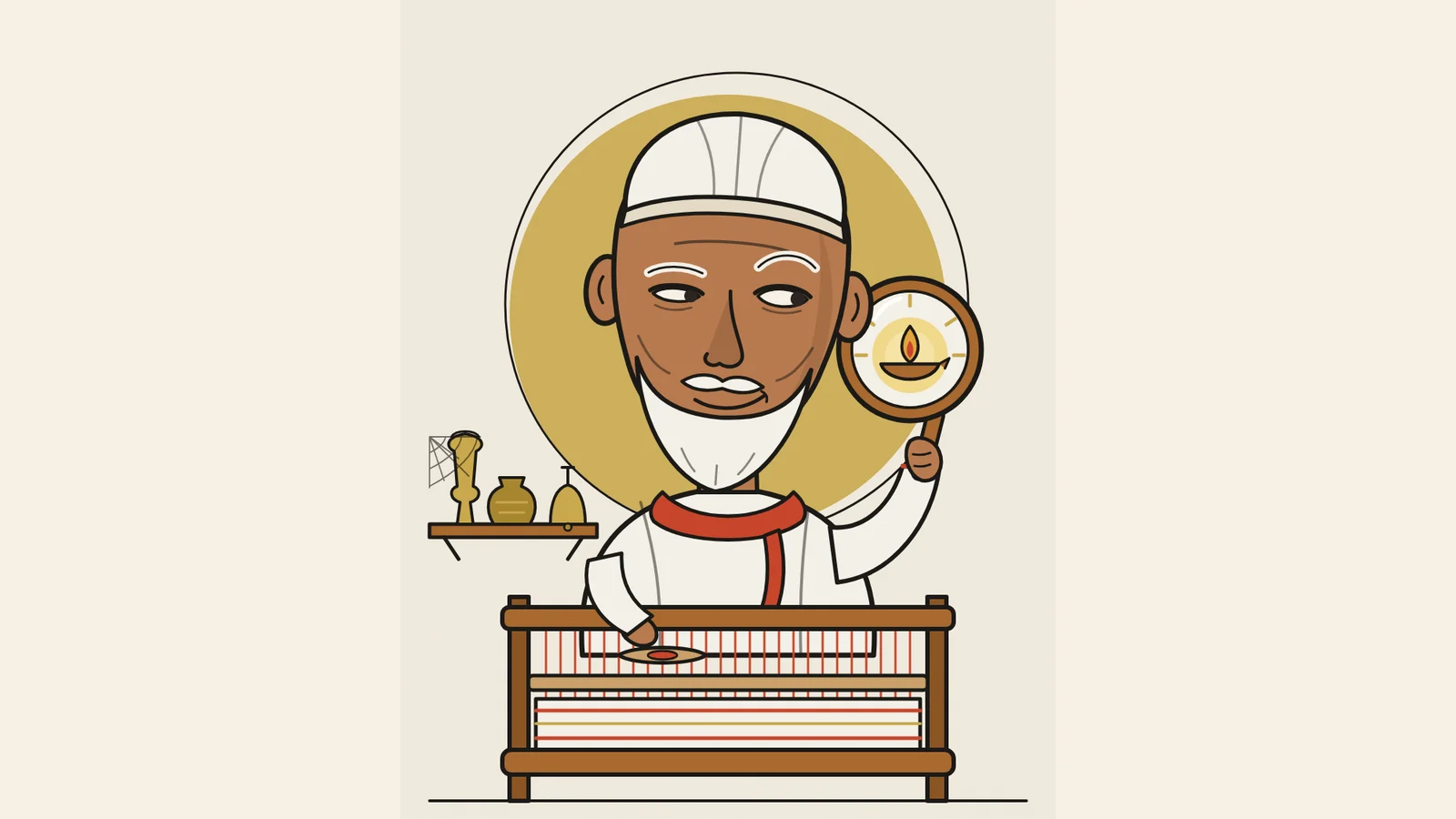
Tradition holds that late in life Kabir left Kashi for Maghar, defying the belief that dying in Kashi brings liberation and dying in Maghar does not. Having taught all his life that outer forms do not decide a person's worth, he tested the teaching against the most powerful form of all, the place of one's death. A weaver who worked at the loom all his life ended it by refusing a ritual comfort he did not believe in.
Ego must go: "When 'I' was, Hari was not; now Hari is, and 'I' am not."
Kabir, sakhi (doha) "जब मैं था तब हरि नहीं, अब हरि हैं मैं नाँहि" (15th c.); Hindi text as printed in NCERT Sparsh II, ch. 1 "Sakhi"Love over book-learning: "Reading books, the world died unwise; one letter of love makes the true pandit."
Kabir, sakhi (doha) "पोथी पढ़ि पढ़ि जग मुवा, पंडित भया न कोइ" (15th c.); Hindi text as printed in NCERT Sparsh II, ch. 1 "Sakhi"Beyond ritual and caste: outer forms, pilgrimages and caste pride do not bring one closer to God; sincerity and the Name do. He was equally critical of empty ritual in every community.
Britannica; Hinduism Today, as given in brief"Keep your critic close; build him a hut in your courtyard."
Kabir, sakhi (doha) "निंदक नेड़ा राखिये, आँगणि कुटी बँधाइ" (15th c.); Hindi text as printed in NCERT Sparsh II, ch. 1 "Sakhi"OPERATING MODEL
BENEFIT MODEL
The leader spends time and reputation only on what produces results and is trusted because they say plainly what is hollow.
People are released from rituals that waste their time and can raise concerns without fear of being punished for it.
Customers get substance, products and service that work, instead of campaigns that only look like change.
Investors can believe what leadership says, because claims are tested against substance before they are made.
Companies that refuse empty display set a more honest standard for public claims about progress and responsibility.
WCRC MODEL PARAMETERS
The scores describe this model's emphasis on each parameter. They are not scores for a person or organisation.
Vision Quotient3 / 5
Impact Index3 / 5
Innovation Score5 / 5
People Leadership4 / 5
Stakeholder Trust5 / 5
Resilience Factor3 / 5
Global Mindset2 / 5
THE AI AGE
AI-washing, transformation theatre and meeting overload are the modern rituals of corporate life. McKinsey's State of AI 2026 found that while nearly nine in ten respondents report regular AI use, 37% attribute at least some EBIT impact to it and only 6% qualify as high performers [1]. Kabir's mirror helps a CEO tell real AI adoption from announcements. Edmondson's work on psychological safety [2] shows why the courage to name empty forms depends on people feeling safe to speak, which is Kabir's critic in the courtyard.
EXECUTION
On Monday, list every recurring meeting and report you own and mark which ones you can link to a result.
Inventory every recurring ritual and initiative, and start the mirror with the CEO.
Deliverable: A ritual and initiative inventory placed on the matrix, with the CEO's own items listed first.
Gate: Baseline recorded for every KPI, the inventory includes the CEO's own rituals, and a standing critic has accepted the role.
Prove in one business that retiring empty rituals returns time without losing what holds people together.
Deliverable: A pilot review list: rituals retired, rituals kept with reasons, and hours returned.
Gate: The pilot business has retired rituals with the hours returned recorded, has kept and explained those that carry meaning, and speak-up safety has not fallen.
Make the substance review annual and bring the mirror into hiring, promotion and public claims.
Deliverable: An annual review procedure, updated promotion criteria and a claim verification step.
Gate: Every public and investor claim about AI or transformation in the period was checked against internal evidence, and promotion panels record evidence of care alongside qualifications.
Keep the mirror pointed at leaders and protect the rituals that carry meaning.
Deliverable: An annual mirror report to the board.
Gate: The annual review has examined the model's own rituals, and initiatives announced a year earlier have documented results or have been stopped.
sponsor: The CEO, because the ego audit has to start with the person whose image is most at stake.
lead: The chief of staff or head of the CEO office, who holds the ritual inventory.
forum: Quarterly in the leadership meeting for retirements and claim checks; annually at the board, with the standing critic present.
decision_rights: The lead can retire any ritual whose owner cannot link it to a result; retiring ceremonies with cultural or community meaning, and any public claim that fails verification, go to the CEO.
Weekly: Leaders re-read outgoing messages for jargon and image-polishing before sending them.
Monthly: The leadership meeting picks one recurring meeting or report and asks what result it changed.
Quarterly: The CEO meets the standing critic, and speak-up safety is checked in a pulse survey.
Annually: The substance review of rituals and initiatives, and a check of last year's announcements against results.
The founder lists every recurring meeting once a year and drops those no one can tie to a result, keeping the rituals that bind the team. An adviser or investor serves as the critic who says which habits have gone hollow.
The CEO office runs the annual substance review as processes multiply, and promotion criteria add evidence of care to qualifications. Leadership messages pass a plain-speech check before release.
The board receives the annual mirror report and hears from the standing critic directly. Claims to investors and the public about AI and transformation are verified against internal evidence before release, with the audit committee checking the trail.
MEASUREMENT AND LIMITS
Number of recurring meetings, reports or ceremonies retired after the annual substance review, with hours returned, from calendar and reporting data.
Share of announced initiatives, including AI initiatives, with a documented measurable result after an agreed period.
Survey items on whether people feel safe pointing out practices that do not work, tracked by level.
Share of public and investor claims about transformation or AI that were checked against internal evidence before release.
RESEARCH SOURCES
The WCRC Guru Management Codex and its 27 models are proprietary WCRC models. © WCRC. All rights reserved.