Karma: work and execution
Karma YogaDoing the work fully and well, without being driven by personal reward.
In practice: Hold yourself and your team to clear delivery standards, and judge by work done rather than credit claimed.
WCRC-GLC-18 — The Renaissance Masters
The WCRC Four-Yoga Leader Model
Every person is potentially great; build all four capacities.
THE MODEL
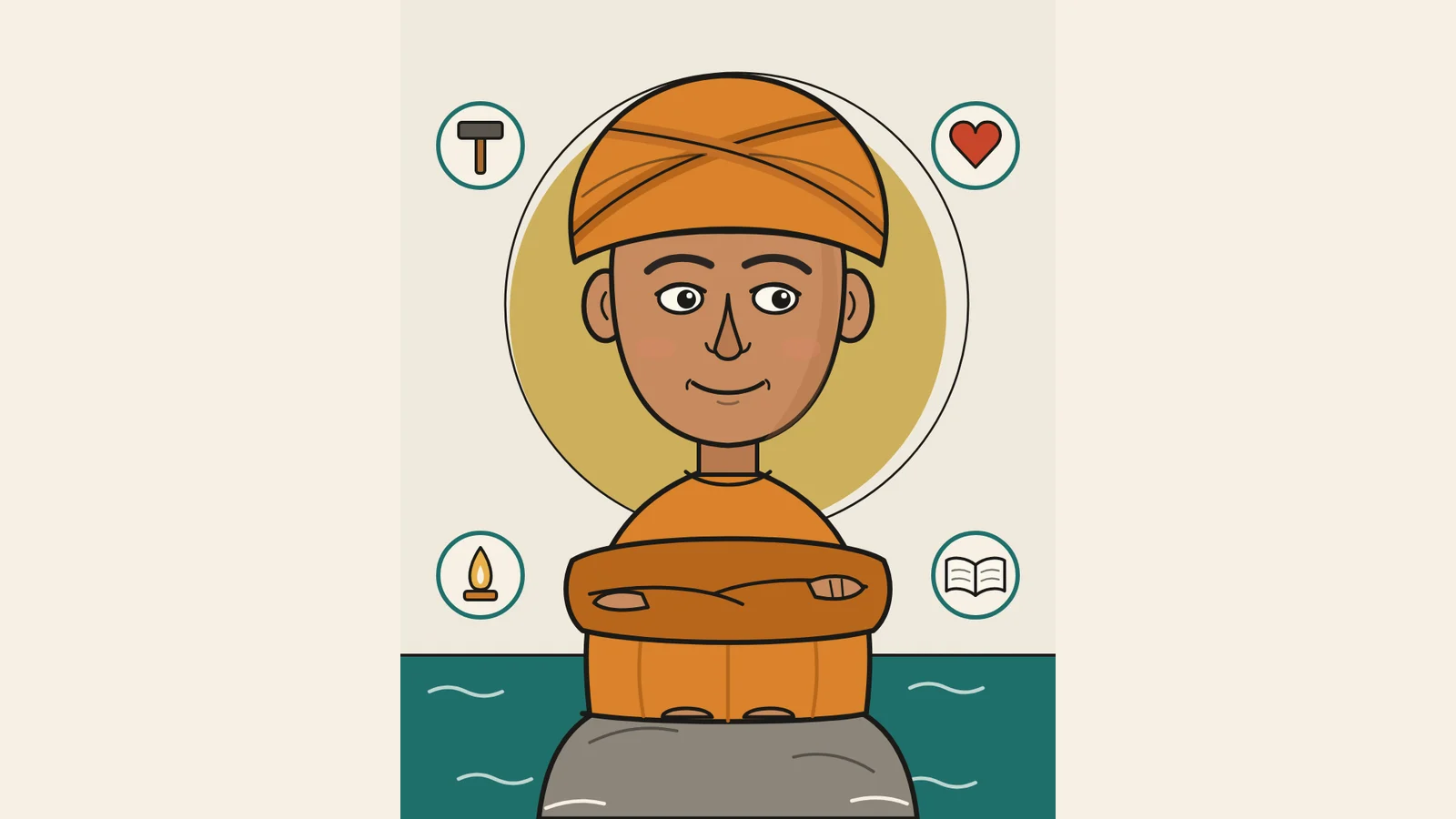
The Four-Yoga Leader Model starts from Vivekananda's premise that every person is potentially divine and treats leadership as the work of bringing that potential out. It draws on his four yogas as four capacities, work, devotion, mastery of mind and insight, which a leader develops in themselves and in others, with character-building as the purpose.
Anchor teaching: "Each soul is potentially divine."
This is a selection of teachers linked with the Hindu tradition, not a ranking. The models offer management reflection, not religious instruction.
WCRC is not affiliated with or endorsed by any teacher or organisation discussed.
MODEL STRUCTURE
Doing the work fully and well, without being driven by personal reward.
In practice: Hold yourself and your team to clear delivery standards, and judge by work done rather than credit claimed.
Wholehearted commitment to a purpose larger than oneself, which gives the work its energy.
In practice: Tie each team's goals to the people the company serves, and tell those stories often.
Control of attention and emotion, so the leader can stay clear under pressure.
In practice: Keep a daily period of focused, undistracted thinking before reacting to the day's demands.
Clear discrimination between what is real and what is assumed, grounded in study.
In practice: Read and reflect a little every day, and test major assumptions before committing to them.
His phrase for education that builds character, strengthens the mind and expands the intellect; here, the leader's duty to grow people.
In practice: Give every manager an explicit goal for how each direct report will grow in character and capability this year.
TEACHING AND CONTEXT
From 1890 to 1893 Vivekananda wandered across India as a monk and saw the poverty of the masses. At the end of 1892 he meditated for three days on a rock off Kanyakumari and resolved on his mission. On 11 September 1893 he opened his address at the World's Parliament of Religions in Chicago with "Sisters and Brothers of America", drew a long standing ovation, and quoted a hymn about many rivers flowing into one sea.
Divinity of the soul: "Each soul is potentially divine"; spiritual life is about bringing that divinity out.
Raja Yoga, Preface, Complete Works Vol. 1Four yogas: work, devotion, mind-control or knowledge are all valid paths; use one or all.
Raja Yoga, Preface, Complete Works Vol. 1Man-making education: education should build character, strengthen the mind and expand the intellect.
Belur Math, quoting VivekanandaHarmony of religions: different paths lead to the same goal; sectarianism and fanaticism are to be rejected.
Chicago address, 11 September 1893, Complete Works Vol. 1OPERATING MODEL
BENEFIT MODEL
The leader has a balanced map of their own strengths and gaps across work, devotion, mind and insight, and a reason to grow in all four.
They are treated as people with large potential and given deliberate help to develop character as well as skills.
They are served by teams that combine competent execution with real care for the people they serve.
A deep bench of rounded leaders reduces dependence on any single individual.
Companies that build character and serve without sectarian division add to the harmony he preached at Chicago.
WCRC MODEL PARAMETERS
The scores describe this model's emphasis on each parameter. They are not scores for a person or organisation.
Vision Quotient4 / 5
Impact Index4 / 5
Innovation Score3 / 5
People Leadership5 / 5
Stakeholder Trust3 / 5
Resilience Factor3 / 5
Global Mindset5 / 5
THE AI AGE
The AI Index 2026 notes that productivity gains from AI are largest in structured, measurable work where outputs are easy to monitor [1], which leaves devotion to purpose, mastery of mind and real insight as the leader's distinctive contribution. Brynjolfsson warns that building AI to automate human work rather than augment human capability risks a "Turing Trap" [2]. The WEF lists resilience, flexibility and agility, and leadership and social influence among the skills employers prioritise [3]. A CEO who develops all four capacities in their people builds an organisation that uses AI as an amplifier of human potential.
EXECUTION
Rate yourself honestly on execution, devotion to purpose, focus under pressure and insight, and pick the weakest of the four to work on first.
See each leader's balance across the four yogas and commit to growing people as well as results.
Deliverable: A four-capacity profile for every leader and a baseline for people growth, internal pipeline and inclusion.
Gate: Every leader has a four-capacity profile and a named weakest capacity, and a baseline is recorded for all four KPIs.
Prove in one unit that man-making goals and work on the weakest capacity change how people grow.
Deliverable: A pilot record of growth goals, mid-point conversations and each leader's practice on the weakest capacity.
Gate: Every direct report in the pilot has a written growth goal and has had a mid-point conversation, and every pilot leader has an active practice on their weakest capacity.
Write character and capacity into how the company reviews and promotes people.
Deliverable: Revised review and promotion criteria and a trained manager group.
Gate: Growth goals appear in every manager's review, and promotion panels are applying the four-capacity criterion.
Keep the four capacities in balance and the language honest over time.
Deliverable: An annual four-yoga review covering balance, people growth, internal pipeline and inclusion.
Gate: Four-capacity balance is tracked year on year, and the internal pipeline and inclusion measures are reported to the board.
sponsor: The CEO, who rates themselves on the four capacities first and shares their weakest with the leadership team.
lead: The CHRO, who runs the four-capacity ratings, growth goals and promotion criteria.
forum: The half-yearly talent review in the leadership meeting, and the board's nomination committee once a year for the internal pipeline.
decision_rights: The lead can set the rating method, growth goal templates and training; changes to promotion criteria and senior appointments go to the sponsor.
Daily: Each leader keeps a short period of focused, undistracted thinking or reading before reacting to the day.
Monthly: Each manager holds a growth conversation with every direct report on character and capability.
Quarterly: Teams hear one story of the people the company served, tying their goals to a purpose beyond themselves.
Annually: Every leader is re-rated on the four capacities, and the internal pipeline is reviewed by the board.
The founder rates themselves on the four capacities, hires a co-founder or early leader strong where they are weak, and sets a growth goal for each early employee. Growth is discussed in one-to-ones every month.
The CHRO runs four-capacity ratings for all managers, growth goals become part of performance reviews, and promotion to senior roles needs strength in three capacities. Managers are trained to give honest feedback.
Four-capacity ratings and growth goals run across all businesses and countries, with the materials framed in plain work terms. The board's nomination committee reviews the internal leadership pipeline and four-capacity balance each year.
MEASUREMENT AND LIMITS
Rate each leader annually on execution, devotion to purpose, focus under pressure and insight, and track how many are strong in at least three.
Record the share of direct reports whose manager-set growth goals for character and capability were met in the year.
Measure the share of senior roles filled by people developed inside the company.
Track employee survey agreement that people of every faith, region and background are treated with equal respect.
RESEARCH SOURCES
The WCRC Guru Management Codex and its 27 models are proprietary WCRC models. © WCRC. All rights reserved.