
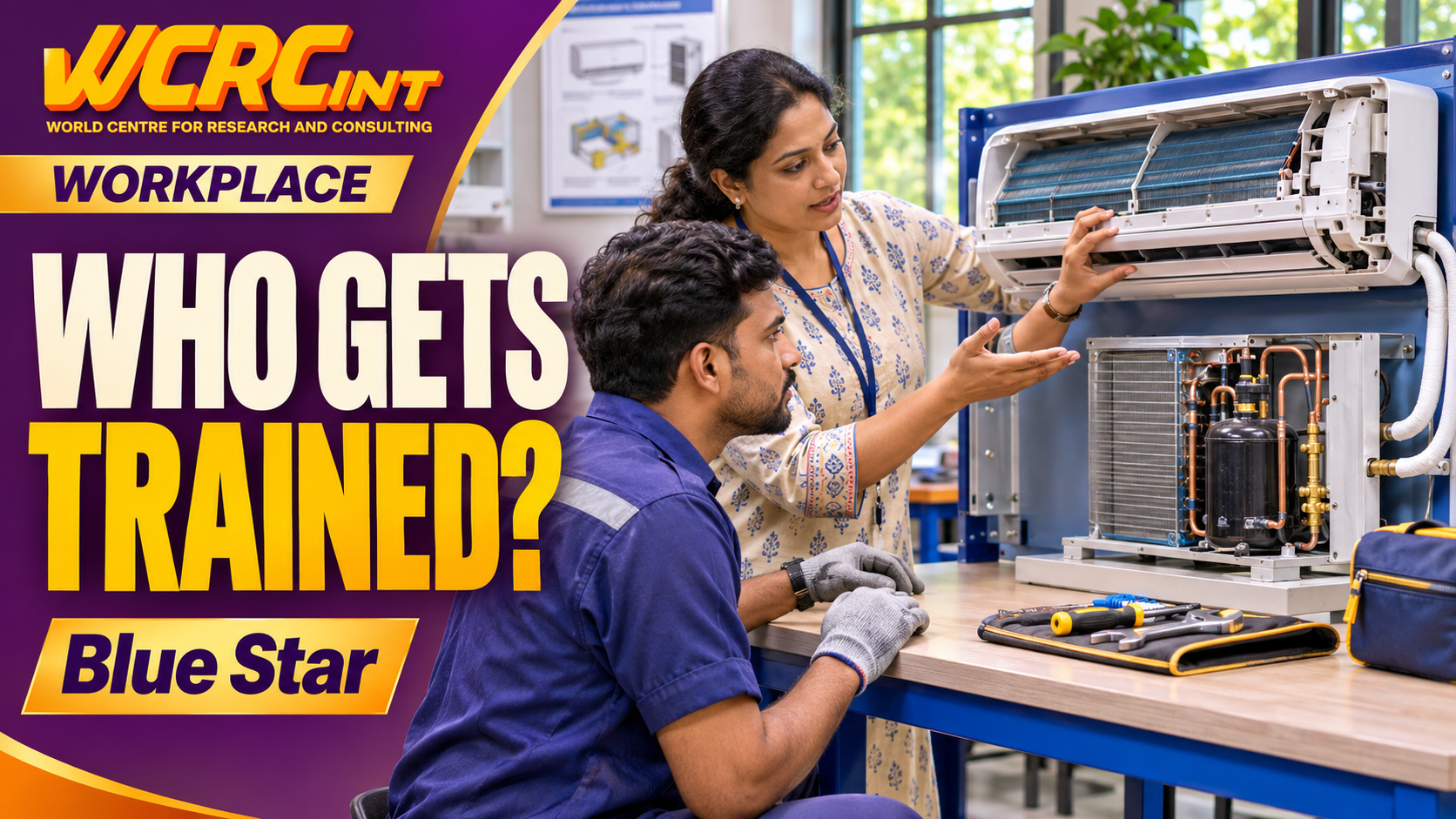
An HVAC business should check training access across the people who perform its service work, including relevant partner teams. A company-wide training total cannot show whether the technician assigned to a particular job is prepared for it.
Blue Star Limited is #230 in WCRC 1000 — India’s Most Valuable Enterprises 2026. The inaugural, pre-assurance edition uses average full equity market capitalisation over 1 July–31 December 2025. That is a financial-market measure; it is not a finding about technician competence or workplace quality.
The company’s careers page, checked on 22 November 2026, identifies Service Marketing, Service Delivery and Service Expertise as engineering career areas. It also describes development opportunities and a channel-based route for much of its product sales. This is a useful public outline of the organisation. It does not disclose training coverage for every worker involved in installation or service.
Begin with the job, then identify the employer
A service visit can involve several organisations between the manufacturer and the customer. A training plan needs to identify which party assigns the work, checks capability and provides supervision. These responsibilities may differ by product and local arrangement.
The first useful exercise is to map one service journey. Who receives the request? Who chooses the technician? What evidence is available that the person can perform the assigned task safely? Which organisation is responsible when further instruction is needed?
This is a proposed exercise for an HVAC service manager. It is not a claim that Blue Star’s current arrangements have a particular gap.
WCRC analysis: access is a question of coverage
Culture Crest’s workplace-equity framework can help frame questions about access to development. It is distinct from the WCRC 1000 financial-ranking methodology. Neither the listing nor this article establishes an employer recognition for Blue Star.
A service organisation could compare training access by role and employment arrangement. That would require a reliable denominator: the people eligible for a specific course or task, rather than everyone carrying a service-related job title. Managers could then examine who attended and who still needs supervised practice.
The next check is practical. A relevant demonstration under suitable supervision can reveal whether someone can apply a procedure. Course attendance alone leaves that question open. Any assessment must use qualified supervision and appropriate safety controls; a customer visit is not a suitable place to improvise a test.
Give the result an owner
A record of a skills gap becomes useful when someone has the authority and resources to address it. That might mean further instruction or a different assignment. The response should follow the actual contractual and supervisory responsibilities rather than assuming that every technician is a manufacturer employee.
This article does not claim that training has reduced repeat visits, raised productivity or improved safety at Blue Star. Those conclusions would require additional evidence. The management question is whether a service business can trace its training promise to the people dispatched to do the work.