
Brands · Analysis
Jio’s historic IPO debut puts India’s digital giant to a harder test
By Abhimanyu Ghosh · Chairman, WCRC ·
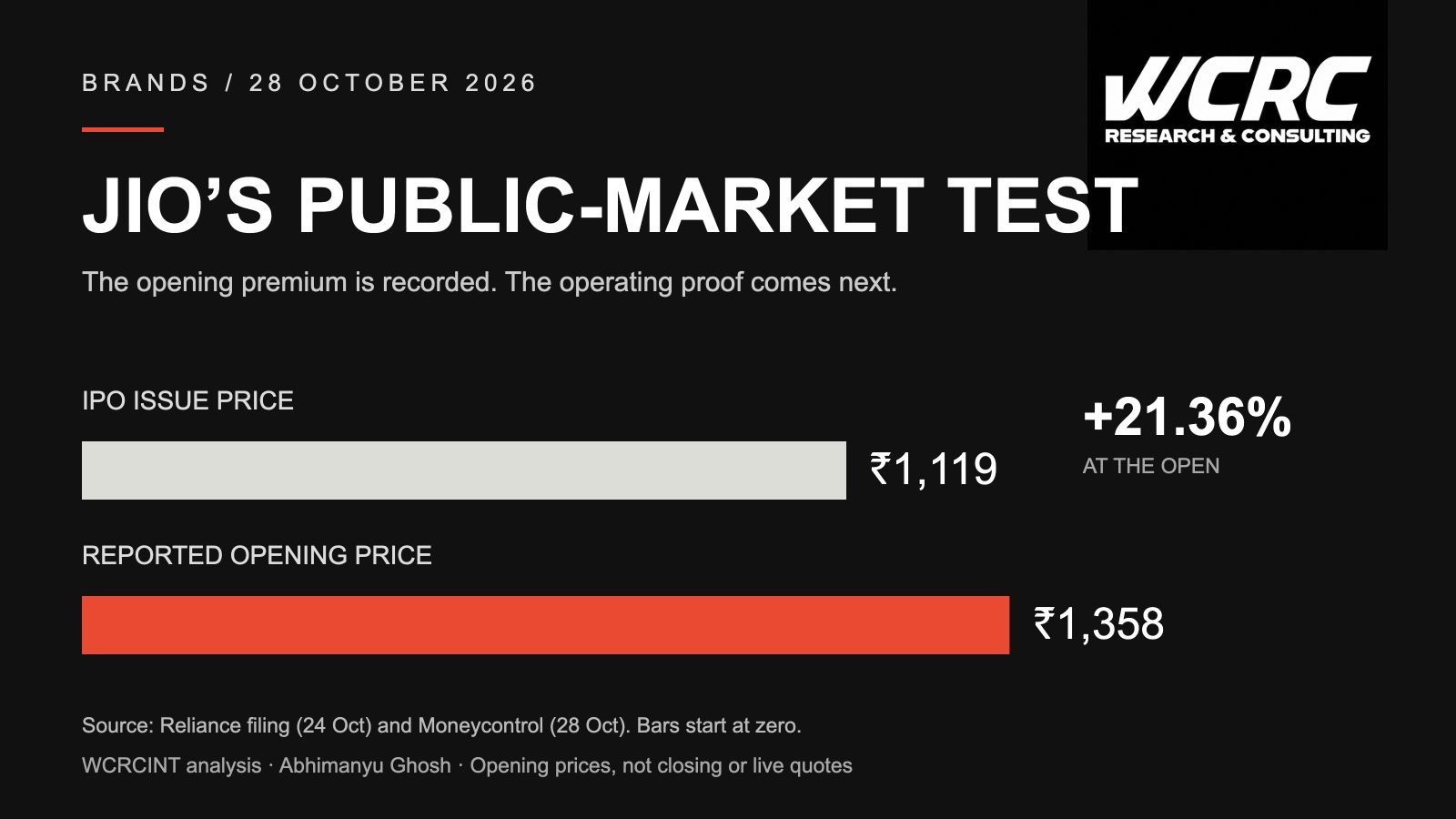
Jio Platforms began trading on 28 October at ₹1,358 a share on the NSE and BSE, Moneycontrol reported, against the ₹1,119 issue price confirmed in Reliance Industries’ 24 October filing. That opening represents a 21.36% premium. The telecoms and digital-services group has arrived with a strong initial market response.
For Jio, the harder test begins after the opening price. A separately traded share gives public investors a direct way to judge the business that Reliance built. The questions become more specific: how much cash does the network retain, how much of the platform opportunity produces measurable revenue, and how clearly can outside shareholders follow the decisions that connect the two?
WCRCINT’s assessment is that Jio’s next source of credibility will be the quality of those answers. The scale of the offering has secured attention. Sustaining confidence will require an account of performance that remains understandable when the first-day excitement has passed.
What happened today
Today is the listing, rather than the opening of the IPO for applications. Reliance’s filing records a subscription window of 21–23 October and a final issue price of ₹1,119. It describes a fresh issue of up to 27 crore shares. The company’s exchange disclosure provides the dated record; the ₹1,358 figure above is the reported opening price, not a closing quotation or a live price.
Multiplying that maximum share count by the issue price gives ₹30,213 crore before adjustments such as the employee discount. That arithmetic ceiling should not be confused with final net proceeds. Net proceeds also deduct issue expenses. For this analysis, “about ₹30,200 crore” is the appropriate scale reference; neither the listing gain nor the amount raised demonstrates a future return for shareholders.
Debt repayment changes the starting point
Crisil Ratings’ assessment dated 28 August identified ₹27,500 crore of the planned fresh issue for prepayment of borrowings. The abridged prospectus hosted by SEBI lists repayment of certain Reliance Jio Infocomm borrowings and general corporate purposes as the objects of the issue. These are stated uses of funds, not evidence that every repayment has already occurred.
That distinction matters to the story being told about the listing. Retiring borrowings can improve financial flexibility and reduce interest costs. It does not automatically create a new revenue stream. A future improvement in earnings therefore needs to be explained: how much came from better operating performance, and how much came from financing changes? Both can benefit a business, but they have different implications for repeatable growth.
Nor should a repayment programme be summarised as “Jio becomes debt-free”. Crisil’s credit analysis includes deferred spectrum liabilities in its treatment of debt. An investor presentation and a credit assessment can consequently show different leverage measures without describing the same set of obligations. Clear definitions and a reconciliation are more informative than selecting the most flattering headline number.
Make the platform case measurable
The SEBI-hosted document reports that Reliance Jio Infocomm accounted for 87.74% of Jio Platforms’ consolidated revenue from operations in FY2026. It also records 533.3 million customers at 30 June 2026. Those are dated disclosures, not October customer totals. Source: abridged prospectus, business and financial summaries.
The analytical question is how much additional economic value can be built around that connectivity base. Distribution at this scale can help a new service reach users. Revenue still depends on whether the service solves a problem people or businesses will pay for. A bundled service, a trial user and a separately paying customer are different commercial outcomes.
For that reason, a platform narrative becomes more persuasive when management can show adoption alongside paid usage, retention and the cost of supplying the service. These are the reporting measures WCRCINT would look for; they are not claims that Jio currently publishes every one of them. An expanding catalogue of digital products is useful context, but it cannot by itself establish their contribution to profit.
The same discipline applies to AI. The prospectus describes AI capabilities and digital services. Their presence in the business does not justify treating all connectivity revenue as software revenue or assuming software-like economics across the group. Investors need to know which activity earns the money, what it costs to operate and how much further capital it requires.
A network still has to earn its investment
Crisil identifies the returns on, and monetisation of, earlier network investment as matters to monitor. It also notes the possibility that further investment or spectrum costs could affect the financial profile. This is the rating agency’s analysis, dated August, rather than a prediction based on today’s share price. Source: Crisil rating rationale.
For public-market scrutiny, the useful test is cash left after the business has maintained and expanded the infrastructure it needs. A quarter of stronger operating earnings deserves attention. So does a later rise in network expenditure. Reading one without the other can make a capital-intensive business appear easier to scale than it is.
Pricing needs similar care. Higher revenue per customer is commercially useful when customers stay and the service continues to justify its price. Management should be judged on the combination. An increase achieved alongside deterioration in retention or service would warrant a different interpretation from an increase supported by stronger customer demand. That is a proposed test, not a finding about Jio’s current service.
Separate listing, connected business
The offer document identifies arrangements with Reliance group businesses among its risks, including Reliance Retail’s role in distributing prepaid connectivity. It also flags exposure arising from shared use of the Jio brand. Source: abridged prospectus, risk summary.
A separate listing gives Jio a distinct market price; it does not make its commercial relationships with the group disappear. The governance task is to make those relationships legible. Outside shareholders should be able to understand what services are provided, how transactions are approved and where costs and benefits sit. This is an argument for clear disclosure, not an allegation that an arrangement is improper.
Brand trust crosses these organisational boundaries more easily than a financial statement does. A customer may encounter the same name across several services while owning shares in only one legal entity. Explaining that boundary is part of protecting the brand: a familiar name should help people understand an offering, rather than obscure who is responsible for it.
The ranking context must keep its dates
Reliance Industries is No. 1 in WCRC 1000 2026. That inaugural, pre-assurance ranking measures average equity market capitalisation over 1 July–31 December 2025. It is historical context about Jio’s parent, not a ranking of the newly listed Jio Platforms or a measure of today’s trading value. The published methodology sets the boundary.
For WCRCINT, the significance of this debut is the opportunity for a more exact discussion of Indian digital enterprise. Jio now has a share price that will move with changing expectations. Its enduring case will depend on something slower to build: evidence that customer reach produces cash, that new services earn their place, and that public shareholders can follow how capital is allocated. The opening premium is recorded. The operating proof will arrive over successive reporting periods.
Analysis based on public filings and attributed reporting. No company interview or first-hand attendance is claimed. This article is not an investment recommendation.