WCRC ORIGINALS™ / RISE & FALL™ / STORY 001
LEGO wasn't short of ideas in 2004. It needed a clearer idea of what its business should be.
The company's own annual report described its most serious financial crisis. A familiar name on the toy-shop shelf had become a difficult business to run. Its recovery required decisions about costs, customers and which activities belonged inside the company.
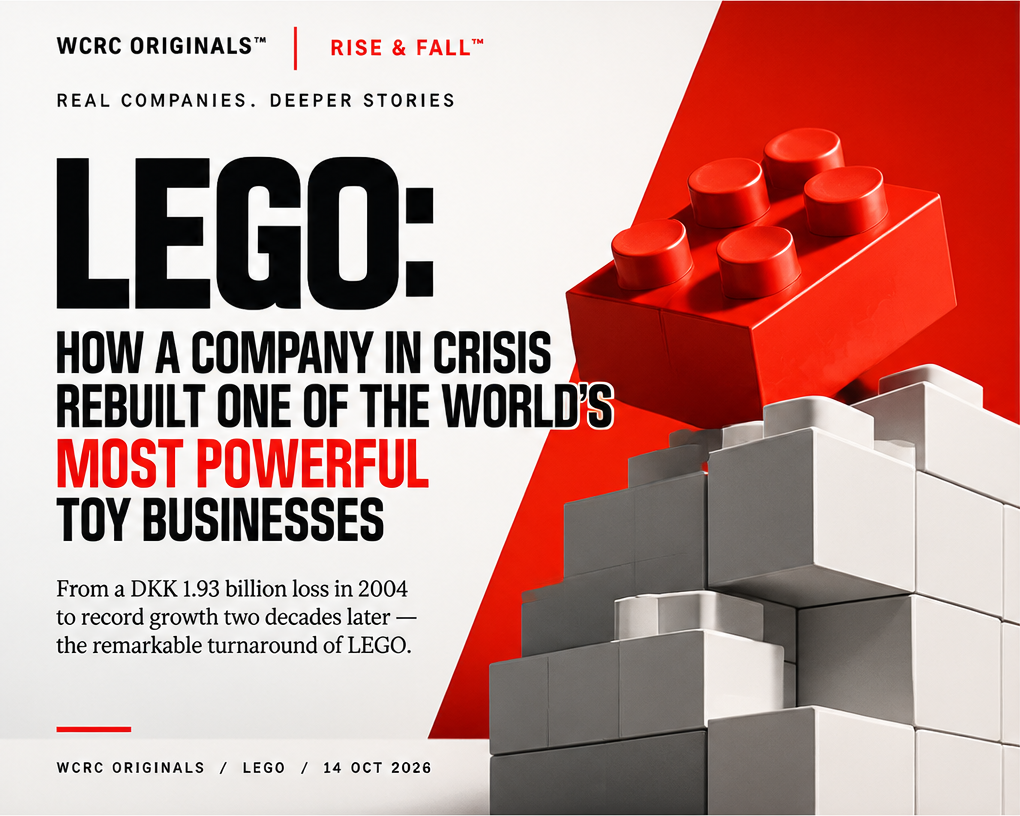
Conceptual editorial illustration for WCRC Originals™ / Rise & Fall™.
The story in 60 seconds
In 2004, the LEGO Group reported a DKK 1.931 billion net loss, including discontinued activities. Restructuring and asset impairments affected that result. During the same year, production and operating costs fell by 20% against 2003. (2004 annual report)
LEGO narrowed its focus around construction play and rebuilt the economics of the business. In 2005, it reported a group net profit of DKK 505 million. (2005 annual report)
Two decades later, FY2025 revenue reached DKK 83.5 billion. The question running through the story is how a company gives its creativity enough operating discipline to survive growth. (FY2025 results)
Lego by the Numbers
| Period | Measure | Reported figure |
|---|---|---|
| 2004 | Group net loss, including discontinued activities | DKK 1.931 billion |
| 2004 | Reduction in production and operating costs against 2003 | DKK 1.523 billion / 20% |
| 2005 | Group net profit, including discontinued activities | DKK 505 million |
| FY2025 | Revenue | DKK 83.5 billion |
| FY2025 | Operating profit | DKK 22.0 billion |
| H1 2026 | Revenue | DKK 41.9 billion |
| H1 2026 | Revenue growth, year on year | 21% |
| H1 2026 | Operating profit | DKK 10.9 billion |
Sources: 2004 report, 2005 report, FY2025 results, H1 2026 results.
These are different accounting measures and reporting periods. The historical net results include discontinued activities; operating profit and revenue are separate measures. A half-year result is not a full-year result.
From a carpenter's workshop to a construction system
Ole Kirk Kristiansen started the business in Billund, Denmark, in 1932. He made wooden toys. The LEGO name came from the Danish words leg godt, meaning "play well". LEGO's February 2026 account dates its official adoption to January 1936. (History of the LEGO name) The brick in its present form arrived in 1958. (LEGO Group history)
Compatibility gave the product an unusual advantage. A child could take apart a model and use the pieces again. A new set could join an existing collection. The purchase did not have to end with the model pictured on the box.
That is central to WCRC's reading of the business. LEGO had a construction system that could accommodate new ideas. Managing the company around that system proved harder than inventing the next product.
When success became complexity
LEGO's 2003 annual report was unusually direct about what had gone wrong. It identified an unsuccessful growth strategy and described plans to reorganise management and return attention to the core business. Sales had declined sharply. (2003 annual report, management review)
Expansion into new activities brought more decisions, more costs and more demands on management. The brand's familiarity could not settle the practical question of whether those activities earned enough to justify their place in the business.
A product can be appealing and still be expensive to produce or difficult to sell profitably. A company with many attractive ideas needs a way to choose between them. LEGO's disclosures show a business having to confront that problem under financial pressure.
The crisis of 2004
The DKK 1.931 billion group net loss made the pressure visible. It should not be read as a loss solely from selling bricks: the figure included discontinued activities and the effects of restructuring and asset impairments. (2004 annual report, financial review)
This distinction matters because a turnaround has several moving parts. Selling more toys, reducing costs and changing the assets a company owns can affect its accounts in different ways. The headline loss explains the urgency; it does not explain the entire business.
The Turning Point™
Jørgen Vig Knudstorp became CEO in 2004. The action plan addressed direction, customer profitability and risk. Production and operating costs fell by DKK 1.523 billion, while the workforce was reduced by approximately 1,000 people. (2004 annual report, pp. 4–7)
The recovery also involved changing the company's activities. The sale of the LEGOLAND parks was completed in 2005. (2005 annual report)
There was a human cost to restructuring, and a leadership change alone cannot account for the work involved. The reset depended on employees and management translating the plan into everyday decisions about the business.
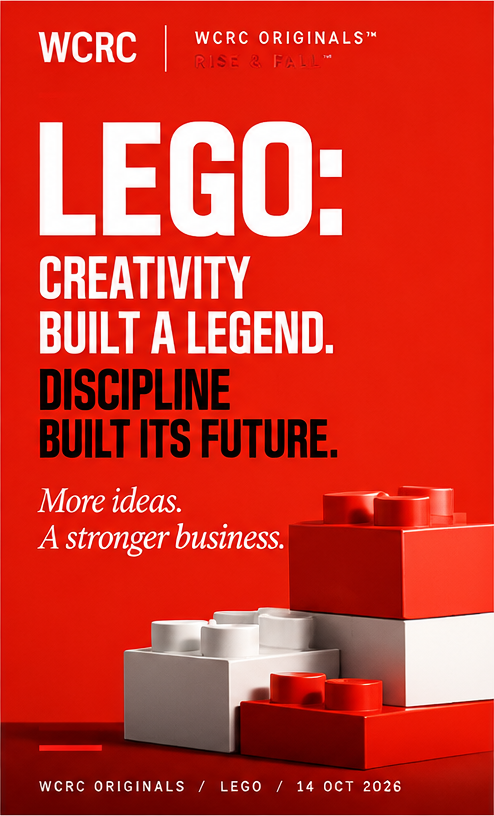
Conceptual editorial illustration: "Creativity built a legend. Discipline built its future."
From restructuring to renewed growth
LEGO's 2005 group net profit was DKK 505 million: DKK 331 million from continuing activities and DKK 174 million from discontinued activities. The split prevents a misleading account of the recovery. The total profit was not all generated by the continuing business. (2005 annual report, financial highlights and review)
By 2008, revenue was DKK 9.526 billion and operating profit before special items was DKK 2.004 billion. The annual report identified City, Creator, Technic and Star Wars among the ranges contributing most to increased sales. (2008 annual report, pp. 2 and 8)
Those products help explain the reset. LEGO could pursue new themes and partnerships through a construction platform customers already understood. Focus still left room for invention.
How LEGO's business model works
The LEGO System of Play gives individual products a relationship with one another. For a customer, a new set can expand what an existing collection can do. For the company, that creates opportunities to introduce themes without rebuilding the entire product proposition each time.
WCRC's assessment is that compatibility supports repeat buying, while the brand can reach children and adults with different interests. Licensed themes connect the system to entertainment properties. Manufacturing and distribution then have to make that promise work at scale.
These are explanations of the business model, not guarantees of future results. LEGO's own crisis shows how much depends on the way the organisation manages the opportunities its products create.
From turnaround to record scale
For FY2025, LEGO reported DKK 83.5 billion in revenue and DKK 22.0 billion in operating profit. It continued spending on production capacity and other strategic initiatives. (FY2025 results, 10 March 2026)
In H1 2026, revenue reached DKK 41.9 billion, up 21% year on year. Operating profit reached DKK 10.9 billion, up 22%. LEGO also reported further market-share gains. (H1 2026 results, 25 August 2026)
The later results establish how far the company travelled. They do not make the intervening years a straight line, or prove that one decision in 2004 caused every later success.
WCRC Intelligence & Analysis™
Innovation without discipline can create complexity faster than it creates value
Every new initiative asks something of the organisation. It needs money, people and management time. It may also introduce production requirements or sales problems that are easy to overlook when the idea itself is exciting.
WCRC reads LEGO's turnaround as a case in deciding which kinds of innovation the business could support. The core construction system gave the company a basis for those choices. Restructuring addressed the cost of activities that no longer fitted the financial reality.
That reading has a limit. Annual reports document decisions and results; they cannot establish a universal formula for turning a company around. LEGO's experience gives leaders a useful question to ask of their own plans: what will this idea require from the business, and what will it add?
Five leadership lessons from LEGO
- Judge growth by its economics. A larger range or a new market brings costs as well as sales opportunities.
- Understand the core advantage. LEGO's construction system gave new products a common foundation.
- Count the cost of complexity. Include the demands on production and management when assessing an initiative.
- Treat stopping as a management decision. A turnaround may require closing or selling activities that once looked attractive.
- Give creativity an operating framework. Clear priorities help an organisation turn ideas into products it can deliver profitably.
These lessons are WCRC analysis of the case.
WCRC Timeline™
| Year | Development |
|---|---|
| 1932 | Ole Kirk Kristiansen starts the business in Billund. |
| 1936 | The LEGO name is officially adopted in January, according to LEGO's 2026 historical account. |
| 1958 | The modern brick design is introduced. |
| 2003 | LEGO acknowledges problems with its growth strategy. |
| 2004 | Financial crisis, restructuring and a change of CEO. |
| 2005 | LEGOLAND parks are sold; the original report records a group net profit. |
| 2008 | Revenue reaches DKK 9.526 billion. |
| 2025 | Revenue reaches DKK 83.5 billion. |
| H1 2026 | Revenue reaches DKK 41.9 billion, up 21% year on year. |
Sources are listed below. Historical amounts follow the original annual reports for the stated years; later reports may present earlier comparatives on a different accounting basis.
The WCRC view
LEGO's crisis put a practical test to its ambition. The company had to decide what it could manage, what customers would buy and what would earn a return.
The recovery gave creativity a business structure that could support it. For leaders reading the case today, the difficult work begins with the same decision: which ideas deserve a place in the company, and which can it afford to leave behind?
WCRC ORIGINALS™ — Research. Intelligence. Reputation.
Research sources
- The LEGO Group history: founding, name and modern brick.
- History of the LEGO name, 11 February 2026: official name adoption in January 1936.
- Annual report 2003: growth strategy and management review.
- Annual report 2004: crisis, leadership, cost reduction and group loss.
- Annual report 2005: LEGOLAND sale and continuing/discontinued profit split.
- Annual report 2008: revenue, operating profit before special items and product ranges.
- FY2025 results, 10 March 2026: full-year revenue and operating profit.
- H1 2026 results, 25 August 2026: half-year results and growth rates.
Leadership lessons and business-model interpretations are WCRC analysis. The illustrations are conceptual artwork, not documentary photographs or financial charts.