
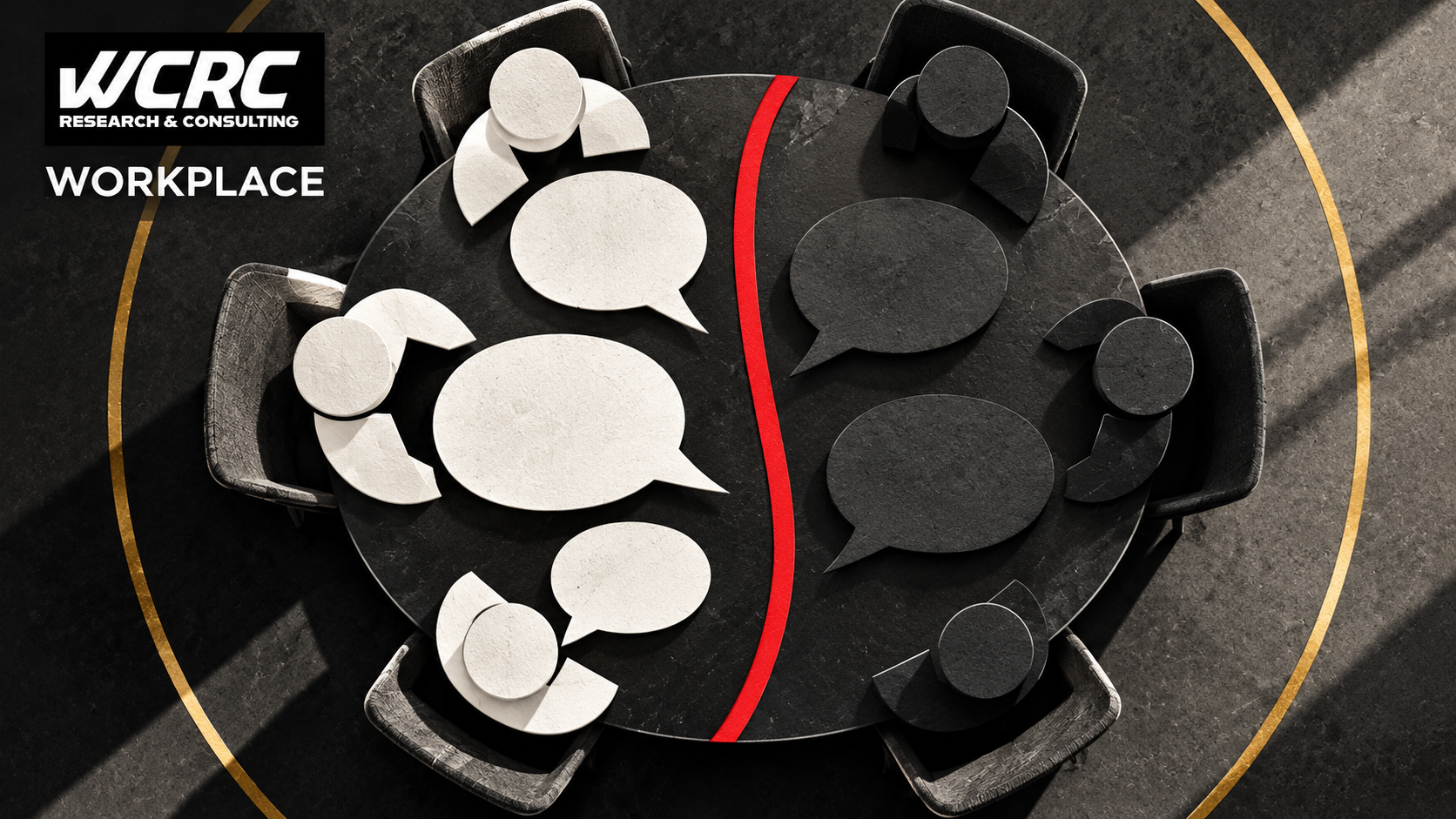
A manager can stop a heated discussion and still leave the underlying workplace problem unresolved. The relevant question is whether employees understand the behaviour expected of them and trust that the same standard applies to everyone.
In a 30 October report, SHRM discusses political friction ahead of the US midterm elections and draws on its Civility Index. That report provides a timely reason to examine workplace conduct. Its publication date should not be confused with the dates on which survey responses were collected. A report about political friction also needs to be read within its research context before its findings are applied to another workforce.
WCRC’s reading applies Psychological Safety and Representation & Inclusion, parameters in the Culture Crest Workplace Value Index. They help examine whether people can express a different view without intimidation or exclusion. The application is conceptual; it is not a Culture Crest assessment of the organisations discussed by SHRM.
Write a rule people can recognise in practice
An instruction to “be civil” leaves room for very different interpretations. A conduct standard becomes more useful when it describes observable behaviour. Repeated personal insults and threats can be identified without requiring a manager to decide which employee holds the more acceptable political opinion.
Disagreement about a work decision poses a related challenge. An employee who questions a staffing plan may sound frustrated. A manager should examine the substance of the concern while addressing any unacceptable behaviour. If tone becomes the only subject of the response, colleagues may learn that raising a difficult operational issue is itself unwelcome.
That is WCRC’s management argument, not a claim that all expressions are appropriate in every setting. A workplace still needs a way to protect people from intimidation and to keep meetings usable. The standard should make those expectations clear enough that employees can predict how it will be applied.
The manager’s own conduct is part of the test
A rule loses credibility when senior people receive exceptions that other employees do not. Management can review whether similar reported behaviour receives a similar response across levels and teams. Differences may be justified by context, but the reason should be capable of explanation.
Team chats also deserve attention. An instruction given in a meeting may not describe how a manager will handle a hostile exchange in a shared channel. People need an accessible reporting route and a way to understand what happens next. Checking whether employees know that route is more informative than assuming that an absence of complaints means the team feels safe.
The organisation should also examine whether quieter people can contribute to decisions. Silence may reflect agreement, fatigue or fear of becoming a target. A manager cannot determine which explanation applies by counting interruptions alone.
The election period makes the topic immediate, but the operating question lasts beyond it. Can an employee disagree, challenge a work assumption or report poor treatment and expect a consistent response? A credible civility standard gives people an answer through conduct they can observe. It protects the possibility of disagreement as well as the people taking part in it.