The 27 models

    WCRC-GLC-04 — The Classical Acharyas

    Basavanna

    The WCRC Kayaka–Dasoha Value Loop

    Honour every role, share what is earned, open the hall.

    Basavanna

    THE MODEL

    The WCRC Kayaka–Dasoha Value Loop

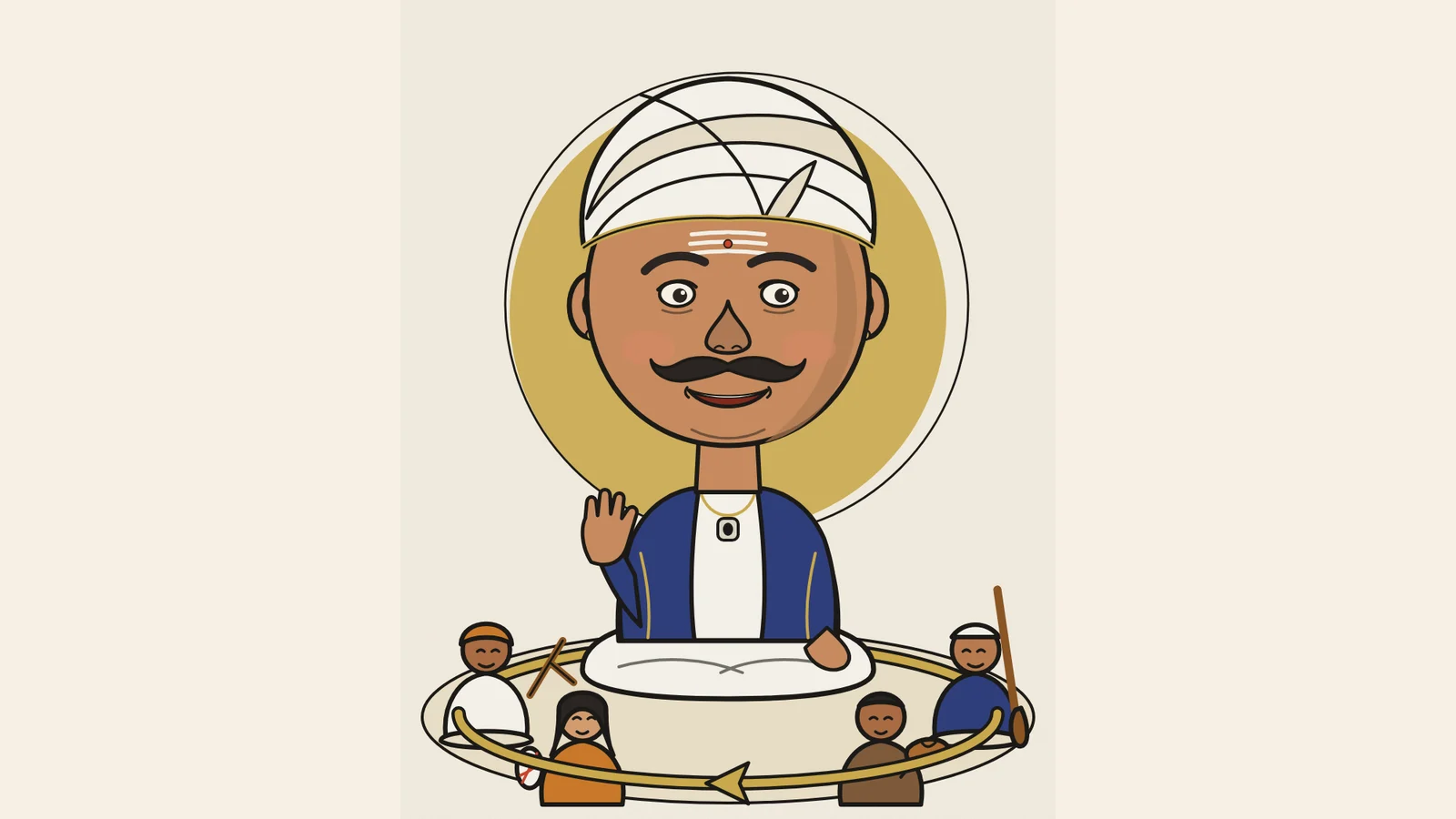
    The Kayaka–Dasoha Value Loop holds that all honest work has dignity, that value created should be shared, and that everyone, from cobbler to queen, deserves a seat in the open hall. Each turn of the loop renews dignity and trust, which drives the next round of value creation.

    Anchor teaching: Kayaka (work as worship) and Dasoha (sharing what is earned)

    This is a selection of teachers linked with the Hindu tradition, not a ranking. The models offer management reflection, not religious instruction.

    WCRC is not affiliated with or endorsed by any teacher or organisation discussed.

    MODEL STRUCTURE

    How it works

    Kayaka–Dasoha01Dignity ofrole02Valuecreated03Valueshared04Open forum05Renewedtrust

    Dignity of every role

    Kayaka

    Every honest role, from the shop floor to the boardroom, is treated as worthy work, and people are not ranked as persons by their job.

    In practice: The CEO spends regular time doing or shadowing front-line work and speaks of it with respect in public.

    Value created

    Work done with care produces value for customers and the enterprise; dignity is the condition for that care.

    In practice: The CEO links each team's work to the customer value it creates, in plain terms.

    Value shared

    Dasoha

    What is earned is shared with those who created it and with those in need, not held only at the top.

    In practice: The CEO sets fair, visible rules for how gains are shared with employees and the community.

    Open forum

    Anubhava Mantapa

    A standing hall where people of every level speak as equals about the work and its purpose.

    In practice: The CEO holds a regular open forum where front-line voices are heard first and decisions follow from what is said.

    Renewed dignity and trust

    When people are respected, share in gains and are heard, trust grows and the loop turns again with more energy.

    In practice: The CEO reports back on what changed because of the forum, closing the loop.

    TEACHING AND CONTEXT

    The thinking behind it

    Basavanna served as chief of the treasury and later a chief minister in the Kalachuri court at Kalyana (Britannica). In the same city he gathered the Anubhava Mantapa, the "hall of experience". Devotees recount that a cobbler, a washerman, a ferryman and Akka Mahadevi sat there together to speak of God, an open forum rare in its time. A man who held the kingdom's treasury chose to build a hall where every worker had a voice.

    Kayaka: honest work of any kind, done with devotion, is sacred; no labour is lowly.

    Bagalkot district site, Govt of Karnataka, as given in brief

    Dasoha and compassion: share what you earn; "Compassion is the root of dharma."

    Bagalkot district site; vachana "Dayavillada dharmavavudayya", as given in brief

    Equality of all devotees: "He is one of us, he is one of us"; birth and caste do not decide holiness.

    Vachana "Ivanarava"; Bagalkot district site; Karnataka Tourism, as given in brief

    The poor devotee's temple: the rich can build temples to Shiva, but a poor devotee has only himself to offer, so his own body becomes the shrine, standing on his legs and crowned by his head. Worth lies in the devoted life, not in what one can afford to build.

    Vachana "Ullavaru Shivalayava maduvaru" (Kannada, 12th c.); WCRC paraphrase from the Kannada

    OPERATING MODEL

    From principle to practice

    Inputs

    • Every role treated as worthy work
    • Fair gain-sharing rules
    • A standing open forum

    Practices

    • Leaders doing front-line work regularly
    • Transparent sharing of gains
    • Front-line voices heard first
    • Reporting back on forum outcomes

    Outputs

    • Higher care in everyday work
    • Ideas from the front line acted on
    • Visible fairness in rewards

    Outcomes

    • Stronger engagement and retention
    • Customer value created by willing people
    • Community standing as a fair employer

    BENEFIT MODEL

    Who it is for

    leader

    The leader gains a workforce that brings care and ideas to the work, and a clear moral basis for decisions about pay and roles.

    employees

    People in every role are respected, heard and share fairly in what they help to create.

    customers

    Customers are served by people who take pride in their work, which shows in quality and attention.

    investors

    A fair, engaged workforce lowers attrition and the hidden costs of disengagement over time.

    society

    Companies that treat all honest work as dignified and share their gains strengthen the communities around them.

    WCRC MODEL PARAMETERS

    Model emphasis

    The scores describe this model's emphasis on each parameter. They are not scores for a person or organisation.

    VisionQuotientImpactIndexInnovationScorePeopleLeadershipStakeholderTrustResilienceFactorGlobalMindset

    Vision Quotient3 / 5

    Impact Index5 / 5

    Innovation Score2 / 5

    People Leadership5 / 5

    Stakeholder Trust4 / 5

    Resilience Factor3 / 5

    Global Mindset2 / 5

    THE AI AGE

    Why it matters now

    As AI absorbs tasks, the question of what makes human work dignified moves to the centre of workforce strategy. The World Economic Forum expects 39% of workers' existing skill sets to be transformed or become outdated over 2025-2030 [1], and Acemoglu and Restrepo argue that automation reduces the labour share while the creation of new tasks raises it [2]. Basavanna's loop asks a CEO to design AI so that it creates new, dignified roles and shares the gains, instead of only removing people. With global engagement at 20% in 2025 [3], the open hall is also a practical answer to disengagement.

    EXECUTION

    Put the model to work

    On Monday, book your first shift doing or shadowing front-line work and set a regular date for the next ones.

    Founder and CEO

    • Work a front-line shift: In the first month, spend time doing or shadowing front-line work and speak about it with respect in your next public message. Founders of small firms can do this weekly; CEOs of large ones should rotate across sites each quarter.
    • Link work to customer value: In your communications, connect each team's work to the customer value it creates, in plain terms. Name roles that are rarely mentioned at leadership level.
    • Set fair gain-sharing rules: Set and publish clear rules for how gains are shared with employees across levels and with the community. Apply the same rules to the top team.
    • Chair the open forum: Chair a regular open forum where front-line voices speak first and you speak last. Commit in the room to what you will decide from what is said.
    • Report back every time: After each forum, report back on what changed because of it and what did not, with reasons. This closes the loop and keeps the forum from becoming theatre.

    Company

    • Check dignity and sharing gaps (CHRO with CFO): Survey whether people at every level feel their role is respected and map which employees are covered by gain-sharing. Compare results across levels and functions to see where dignity and sharing break down.
    • Pilot a forum in one site (Site or unit head): Run an open forum in one site or unit for a quarter, with front-line voices heard first and a named owner logging each suggestion and its outcome. Have leaders in the same unit do regular front-line shifts.
    • Embed kayaka and dasoha (CEO office, CHRO and CFO): Write gain-sharing rules into reward policy so coverage reaches every level, and make respect for every role a criterion in hiring and promoting managers. Set working-hours limits so 'work is worship' cannot be used to justify overwork.
    • Train managers to run forums (CHRO): Train all people managers to run open forums where they speak last, act on front-line suggestions and report back. Include how to plan redeployment for roles affected by automation.
    • Measure the value loop (Forum owners and HR): Track front-line voice to action, gain-sharing reach, role dignity score and redeployment after automation, and publish them internally every quarter. Show the gaps between levels openly.
    • Scale forums and review sharing (CEO and board): Extend forums to every site once the pilot shows suggestions being acted on, and review gain-sharing rules every year for fairness. Stop any forum that has become theatre and restart it with a new owner.

    Readiness check

    Before starting

    • Would our senior leaders do front-line work without turning it into a photo opportunity?
    • Can we explain to every employee how gains are shared and why?
    • Are we ready to act on what the front line says, and to report back when we do not?
    Days 0–30

    Phase 1 · Diagnose and commit

    Find where dignity and sharing fall short across roles before promising anything.

    • The CHRO and CFO compare gain-sharing coverage, pay structure and role dignity survey results by level and function.
    • The CEO works or shadows front-line shifts at more than one site (Kayaka).
    • Map each team's work to the customer value it creates, naming roles rarely mentioned at leadership level (Value created).
    • Choose a pilot site for the first Anubhava Mantapa forum.

    Deliverable: A dignity and sharing gap report by level and function.

    Gate: Baseline recorded for every KPI, the gap report shared with the leadership team, and a site head agreed to host the first forum.

    Days 31–90

    Phase 2 · Pilot and prove

    Prove that an open forum where the front line speaks first leads to decisions people can see.

    • Run the open forum at the pilot site with front-line voices first and the CEO speaking last.
    • Log every suggestion with an owner and a decision date.
    • Report back after each forum on what changed and what did not, with reasons (Renewed dignity and trust).
    • Draft gain-sharing rules that apply equally to the top team (Dasoha) and put them to employee representatives.

    Deliverable: A forum action log and a draft gain-sharing rulebook.

    Gate: Every suggestion from the pilot forum has a recorded decision and a report-back, and employee representatives have reviewed the draft gain-sharing rules.

    Days 91–180

    Phase 3 · Embed and scale

    Make the loop standard: forums at every site, published sharing rules and redeployment for automated roles.

    • Publish the gain-sharing rules across levels, including the share set aside for the community.
    • Train managers to run forums and report back, with chairs rotating among front-line staff.
    • Commit to redeployment for roles affected by automation and AI, with a plan for each role before it changes.
    • Extend forums to all sites on a published calendar.

    Deliverable: Published gain-sharing rules and a forum calendar for every site.

    Gate: Gain-sharing coverage is published by level, forums run at every site with report-backs logged, and a redeployment plan exists for every role scheduled for automation.

    Month 7 onwards

    Phase 4 · Sustain and renew

    Keep the loop honest, so devotion to work never becomes cover for overwork or low pay.

    • Review each year whether gains actually shared match the published rules.
    • Check hours and pay in roles that leaders praise publicly as kayaka.
    • Track where people whose tasks were automated now work.
    • The CEO continues front-line shifts on a rotating basis.

    Deliverable: An annual value-loop report covering voice to action, gain-sharing reach, role dignity and redeployment.

    Gate: Role dignity scores at front-line levels are closing the gap with management levels, and the gains actually shared match the published rules.

    Governance

    sponsor: The CEO with the board, because gain-sharing rules touch pay at every level, the top team's included.

    lead: The CHRO, working with the CFO on sharing and with site heads on forums.

    forum: Monthly in the leadership meeting for the forum action log; quarterly at the board remuneration committee for gain-sharing and redeployment.

    decision_rights: The lead can act on forum suggestions within site budgets and set forum formats; changes to gain-sharing rules, and any automation that removes a role without redeployment, go to the CEO and the board.

    Cadence

    Weekly: Site heads update the status of forum suggestions where staff can see it.

    Monthly: An open forum at each site, front line first, opening with a report-back on last month's suggestions.

    Quarterly: The CEO works a front-line shift at a rotating site, and the remuneration committee reviews gain-sharing reach.

    Annually: The value-loop review of sharing outcomes, redeployment and role dignity scores, shared with all staff.

    By company stage

    startup

    The founder works alongside every role in the early months and shares gains through a simple published bonus or equity rule that covers the whole team. A monthly open meeting where the newest and most junior people speak first serves as the hall.

    scaleup

    The CHRO writes gain-sharing rules by level, and site heads run forums with logged report-backs. Leaders rotate front-line shifts across locations as the company spreads.

    enterprise

    Gain-sharing rules, redeployment commitments for automated roles and forum outcomes are reported to the board remuneration committee. Forums run in local languages at every site, and the board compares role dignity scores across levels, not only overall engagement.
    Success looks like

    • Front-line staff can name a change that came from something they said in a forum.
    • Gain-sharing rules are known across levels and the top team is seen to follow them.
    • People whose tasks were automated are working in new roles inside the company.

    MEASUREMENT AND LIMITS

    What to watch

    Front-line voice to action

    Number of front-line suggestions from open forums that were implemented, with the time taken, logged by the forum owner.

    Gain-sharing reach

    Share of employees, by level, covered by profit-sharing, bonus or other gain-sharing schemes, from HR records.

    Role dignity score

    Survey items on whether people feel their role is respected by leadership, compared across levels and functions.

    Redeployment after automation

    Share of roles affected by automation whose holders moved into new roles inside the company, from workforce planning data.

    Failure modes

    • "Work is worship" is used to justify overwork or low pay in the name of devotion to the company.
    • The open forum becomes theatre: people speak, nothing changes, and trust falls faster than if there had been no forum.
    • Sharing is announced but uneven, so the gap between words and rewards damages the loop.

    Execution risks

    • 'Work is worship' becomes a cover for overwork or low pay.: Overtime rises in roles praised publicly while pay gaps stay the same. Mitigation: Pair any public praise of a role with a CHRO check on its hours and pay, and act on what the check finds.
    • The forum becomes theatre and cynicism grows.: Attendance falls, the same few people speak, and suggestions pass their decision dates without an answer. Mitigation: Publish the decision log, report back every time and rotate the chair among front-line staff.
    • Leaders apply the sharing rules to others but not to themselves.: Top-team bonuses rise while the front-line share stays flat. Mitigation: Apply the same rules to the top team and publish outcomes by level.
    • Front-line staff will not speak openly in front of senior people or in head-office language.: Forums at some sites produce no critical suggestions at all. Mitigation: Collect anonymous inputs before each forum, run forums in the local working language and let a front-line chair lead.