The 27 models

    WCRC-GLC-10 — The Bhakti Saints

    Goswami Tulsidas

    The WCRC PurposeTurn Model

    Redirect your strongest passion into lasting service to others.

    Goswami Tulsidas

    THE MODEL

    The WCRC PurposeTurn Model

    The PurposeTurn Model treats a wake-up moment as the start of a redirection: the leader keeps the full force of their passion and points it at serving others. Service to others becomes the test of every choice in the pivot, the energy goes into building one work that lasts, and that work is made in the language of the people it serves.

    Anchor teaching: परहित सरिस धरम नहिं भाई (No dharma equals doing good to others), Ramcharitmanas, Uttar Kand 41.1 (Gita Press)

    This is a selection of teachers linked with the Hindu tradition, not a ranking. The models offer management reflection, not religious instruction.

    WCRC is not affiliated with or endorsed by any teacher or organisation discussed.

    MODEL STRUCTURE

    How it works

    01Raw passion02Wake-upmoment03Purpose:parahit04Lasting work05Reach to allSame energy, new direction

    The wake-up moment

    Recognise the moment that shows the old direction cannot hold, often in words someone close has the courage to say.

    In practice: After a shock or a hard piece of honest feedback, the CEO writes down what it revealed before deciding anything.

    Redirect the passion

    Keep the energy and change its object; suppressing it wastes the very force the pivot needs.

    In practice: Leaders map what their teams care about most and point that energy at the new problem instead of shutting it down.

    Service of others

    Parahit

    Doing good to others is the highest duty and the test of the new direction; causing harm is the lowest act.

    In practice: Every pivot option is assessed first on who it serves and who it could hurt.

    Build the lasting work

    Pour the redirected energy into one durable work, as the Ramcharitmanas took more than two years of steady effort.

    In practice: The company commits multi-year resources to one flagship and protects it from quarterly cuts.

    Speak to everyone

    Make the work in the language of the people it serves, as Tulsidas chose Awadhi over Sanskrit.

    In practice: The pivot is explained to customers and frontline staff in their own languages, including regional languages where relevant.

    TEACHING AND CONTEXT

    The thinking behind it

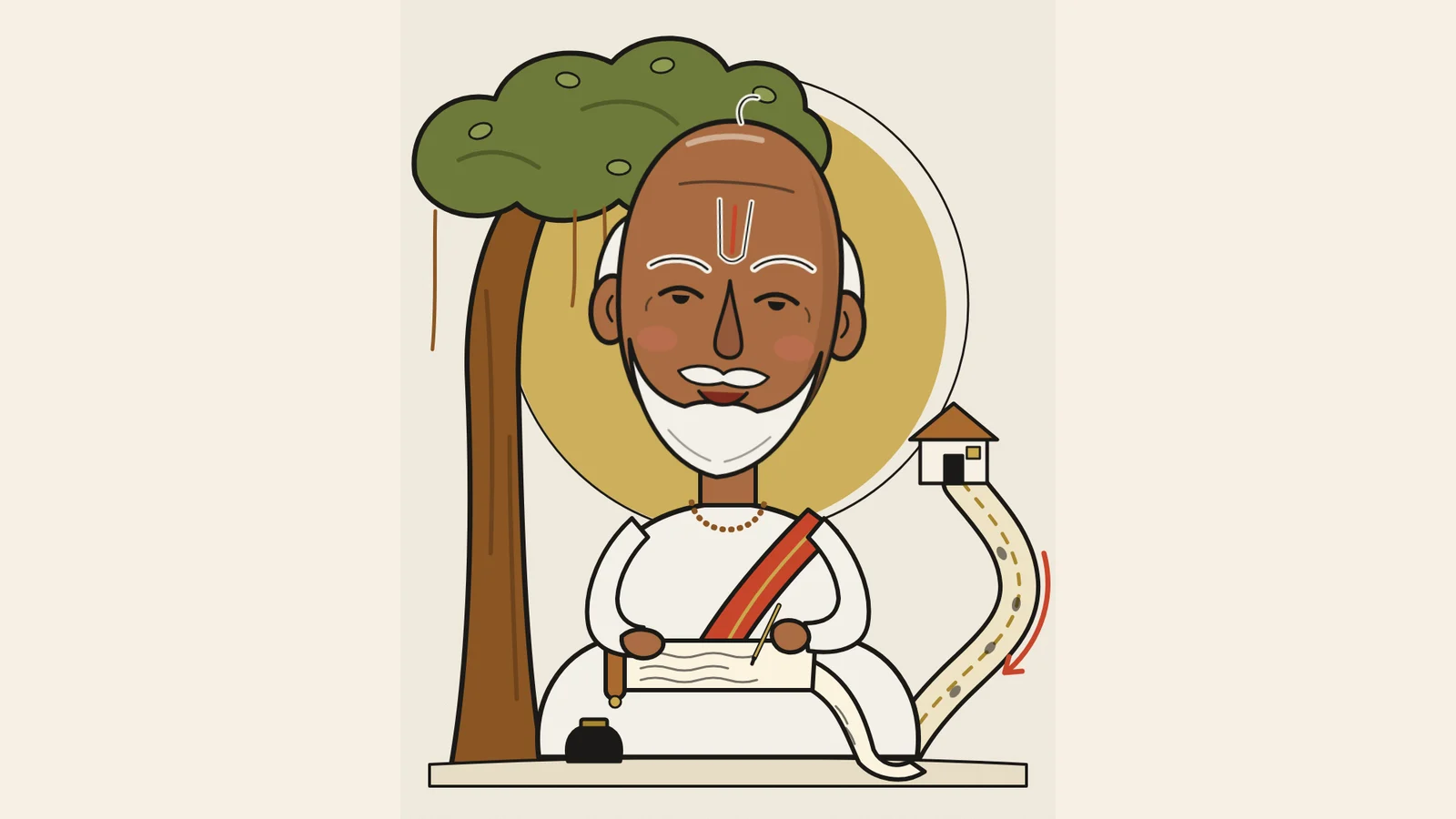
    Devotees recount that young Tulsidas, unable to bear being apart from his wife Ratnavali, followed her to her father's house, and she told him that if he loved Rama as he loved this body of bone and skin, he would be free. He left home that day. The same intensity later went into the Ramcharitmanas, begun in 1574/75 and written in Awadhi so ordinary people could hear it, and Ramlilas have staged it across North India since the late 16th century.

    Serving others is the highest dharma; causing others pain is the lowest act.

    Ramcharitmanas, Uttar Kand 41.1 (Gita Press numbering)

    Ratnavali's words: if he loved Rama as he loved this body of bone and skin, he would be free.

    Hinduism Today; Hindupedia (devotees recount, as given in brief)

    Devotion in the people's language: he wrote in Awadhi so devotion would reach everyone, beyond the circle of Sanskrit scholars.

    Britannica, 'Ramcharitmanas' (as given in brief)

    Knowing the whole world as filled with Sita-Rama, bow to all with folded hands.

    Ramcharitmanas, Bal Kand (Gita Press; numbering to be checked per brief)

    OPERATING MODEL

    From principle to practice

    Inputs

    • An honest signal that the old path fails
    • Energy and skills already in the team
    • A clear view of who is served

    Practices

    • Assess options on benefit and harm
    • Point passionate teams at the new mission
    • Fund one multi-year flagship work
    • Communicate in stakeholders' own languages

    Outputs

    • A pivot that keeps its talent
    • A flagship product or institution
    • Messages understood across regions

    Outcomes

    • Growth on a durable purpose
    • Lower attrition through change
    • Reputation as a company that serves

    BENEFIT MODEL

    Who it is for

    leader

    The leader gets a way to change direction without losing the drive and identity that built the company.

    employees

    People keep their passion and skills and see them put to a purpose worth the effort.

    customers

    Customers are served by work built around their needs and explained in words they understand.

    investors

    The pivot is anchored in a lasting body of work, which makes the new direction easier to judge over time.

    society

    The company's energy moves towards doing good and away from causing harm, and reaches people beyond elite audiences.

    WCRC MODEL PARAMETERS

    Model emphasis

    The scores describe this model's emphasis on each parameter. They are not scores for a person or organisation.

    VisionQuotientImpactIndexInnovationScorePeopleLeadershipStakeholderTrustResilienceFactorGlobalMindset

    Vision Quotient5 / 5

    Impact Index5 / 5

    Innovation Score4 / 5

    People Leadership3 / 5

    Stakeholder Trust3 / 5

    Resilience Factor3 / 5

    Global Mindset2 / 5

    THE AI AGE

    Why it matters now

    The World Economic Forum expects two-fifths (39%) of workers' existing skill sets to be transformed or become outdated over 2025 to 2030 [1], so careers and companies are being pushed to pivot. The open question is where the energy goes. Acemoglu and Restrepo argue that automation always reduces the labour share in value added, while creating new tasks always raises it [2]. A founder who redirects talent towards new work that serves others, augmenting people rather than only replacing them [3], is making the Tulsidas pivot.

    EXECUTION

    Put the model to work

    On Monday, write down what the latest shock or hard piece of honest feedback revealed about your current direction, before deciding anything.

    Founder and CEO

    • Write down the wake-up: In the first week after a shock or honest feedback, write down what it revealed before deciding anything. Separate a real signal from ordinary criticism so you do not pivot on impulse.
    • Thank the honest voice: Thank the person who had the courage to say it and ask them what else you are missing. Keep them close through the change.
    • Ask who it serves: Assess each pivot option first on who it serves and who it could harm, and write the answer down alongside the financial case. Drop options whose main effect is harm, however attractive.
    • Point passion at the mission: Meet the people who carried the old direction, learn what they care about most and give them a part in the new mission. Founders can do this person by person; CEOs of large firms should do it with business heads.
    • Protect the flagship work: Commit to one multi-year flagship and defend its funding yourself at every budget cycle. Explain the change to customers and frontline staff in their own languages.

    Company

    • Assess the wake-up signal (CEO office with strategy team): Gather the evidence that the old path is failing and map the energy and skills already in the team. Identify the key staff whose retention matters most through the change.
    • Pilot with one passionate team (One business head): Point one team's strongest interest at the new mission for a quarter and track who stays and how they engage. Run a benefit and harm review on the pilot.
    • Embed benefit and harm reviews (CEO office and board): Require a documented benefit and harm review for every major pivot decision, and ring-fence multi-year flagship funding in the budget process. Add contribution to the new mission to performance reviews.
    • Train managers to redirect energy (CHRO): Train all people managers to redirect their teams' passion toward the new mission without suppressing it, and to explain the change in staff's own languages. Include how to spot early signs of key staff leaving.
    • Track the pivot measures (CHRO with CFO): Track talent retained through the pivot, benefit and harm reviews, flagship continuity and language reach, and report them to the board every quarter. Compare retention with the period before the change.
    • Scale and review the purpose (Board): Extend the new direction across the company once the pilot keeps its talent, and review each year whether the flagship still serves people. Stop any service claim that has no lasting work behind it.

    Readiness check

    Before starting

    • Can we tell a real wake-up signal from ordinary criticism?
    • Have we identified the people who carry the old passion and how to keep them?
    • Can we protect a flagship's funding over several years?
    Days 0–30

    Phase 1 · Diagnose and commit

    Test whether the wake-up signal is real before committing to a pivot.

    • The CEO writes down what the shock or honest feedback revealed before deciding anything (The wake-up moment).
    • The CEO office and strategy team test the signal against evidence and separate it from ordinary criticism.
    • Map what teams care about most and who carries that passion (Redirect the passion).
    • List pivot options and assess each first on who it serves and who it could hurt (Parahit).

    Deliverable: A written wake-up assessment and a benefit-and-harm review of each pivot option.

    Gate: Baseline recorded for every KPI, the wake-up signal tested against evidence and not a single criticism, and every pivot option has a written benefit-and-harm review.

    Days 31–90

    Phase 2 · Pilot and prove

    Prove that a team's existing passion can be redirected to the new problem without losing its people.

    • Pilot the pivot with one team that cares deeply about the old work.
    • Point that team's energy at the new problem instead of shutting it down, with its leaders shaping how.
    • Track who stays engaged, who drifts and who leaves.
    • Explain the pivot to the pilot's customers and frontline staff in their own languages (Speak to everyone).

    Deliverable: A pilot report on talent retained and early evidence of service to the people the pivot is meant for.

    Gate: The pilot team's key people are still in the work, the pivot has been explained in every language its customers and staff use, and the harm review has been updated with what the pilot learned.

    Days 91–180

    Phase 3 · Embed and scale

    Commit lasting resources to one flagship and make benefit-and-harm review standard.

    • Commit multi-year resources to one flagship and protect it from quarterly cuts (Build the lasting work).
    • Make a benefit-and-harm review a standing step for every major pivot decision.
    • Train managers to redirect their teams' energy instead of suppressing it.
    • Extend explanation of the pivot to every language group among customers and staff.

    Deliverable: A board-approved multi-year flagship commitment and a standing benefit-and-harm review step.

    Gate: The flagship has a multi-year commitment approved by the board, and every major pivot decision in the period went through a benefit-and-harm review.

    Month 7 onwards

    Phase 4 · Sustain and renew

    Keep the flagship alive and the purpose honest over the years.

    • Protect the flagship's funding in each budget round.
    • Track retention of the people who carried the old passion.
    • Gather evidence each year of service to the people the flagship was built for.
    • Test any new wake-up signal with the same rigour before starting another pivot.

    Deliverable: An annual purpose and flagship review to the board.

    Gate: The flagship has kept its funding through every budget round, and its service to the people it was built for can be shown with evidence.

    Governance

    sponsor: The CEO with the board, because only they can protect a multi-year flagship from quarterly pressure.

    lead: The head of strategy, with the CHRO responsible for talent retained through the pivot.

    forum: Monthly in the leadership meeting while the pivot is under way; quarterly at the board for flagship continuity and harm findings.

    decision_rights: The lead can redirect team resources within the flagship; starting a new pivot, cutting flagship funding or overruling a harm finding goes to the CEO and the board.

    Cadence

    Weekly: The pivot lead and team leaders review who is engaged and who is drifting.

    Monthly: The leadership meeting reviews talent retained and flagship progress.

    Quarterly: The board confirms flagship funding is intact and reviews benefit-and-harm findings.

    Annually: The board revisits the purpose behind the pivot and reviews language reach among customers and staff.

    By company stage

    startup

    The founder tests a wake-up signal with customers before pivoting and carries the team's existing enthusiasm into the new direction. The flagship is the one product the company commits to for several years instead of chasing each quarter's trend.

    scaleup

    The strategy head runs benefit-and-harm reviews on pivot options, and the CHRO tracks retention of key people. The pivot is explained in each language the company's customers and staff use.

    enterprise

    The board approves multi-year flagship funding and protects it in budget rounds, with benefit-and-harm reviews attached to major pivots. Investor and public communication explains whom the pivot serves and what it costs, in the languages of every market served.
    Success looks like

    • People who carried the old passion are leading parts of the new work.
    • The flagship has survived budget rounds and serves the people it was built for.
    • Customers and frontline staff in every language group can explain why the company changed direction.

    MEASUREMENT AND LIMITS

    What to watch

    Talent retained through the pivot

    Retention of identified key staff over the 12 months after the change of direction, compared with the previous period.

    Benefit and harm reviews

    Share of major pivot decisions with a documented assessment of who is served and who could be harmed.

    Flagship continuity

    Whether the flagship's planned multi-year funding was kept intact at each budget cycle.

    Language reach

    Share of customer and staff communications about the change available in the languages those groups use.

    Failure modes

    • Pivoting on impulse, treating every criticism as a wake-up moment.
    • Suppressing the old passion instead of redirecting it, and losing the people who carried it.
    • Service becomes a slogan with no lasting work behind it.

    Execution risks

    • The company pivots on impulse.: Strategy shifts after a single complaint, headline or board remark. Mitigation: Require a written wake-up assessment tested against evidence before any pivot is approved.
    • The people who carried the old passion leave.: Long-serving experts resign or go quiet in the months after the announcement. Mitigation: Map who carries the passion, give them leading roles in the new work and track their retention monthly.
    • Service becomes a slogan while the lasting work is starved.: Purpose language grows in communications while the flagship budget is trimmed. Mitigation: Ring-fence the flagship budget and report its continuity to the board each quarter.
    • Regions and language groups are left out of the pivot.: Regional staff and customers hear about the pivot second-hand and repeat confused versions of it. Mitigation: Explain the pivot in every working language through local managers before public announcement.